

Author: Jaziba Luqman
Last updated: October 2026
Jaziba Luqman writes TheDailyFront's wheelchair-accessibility travel series, cross-checking tourism claims against official accessibility databases, municipal portals, operator listings, and first-hand traveler accounts.
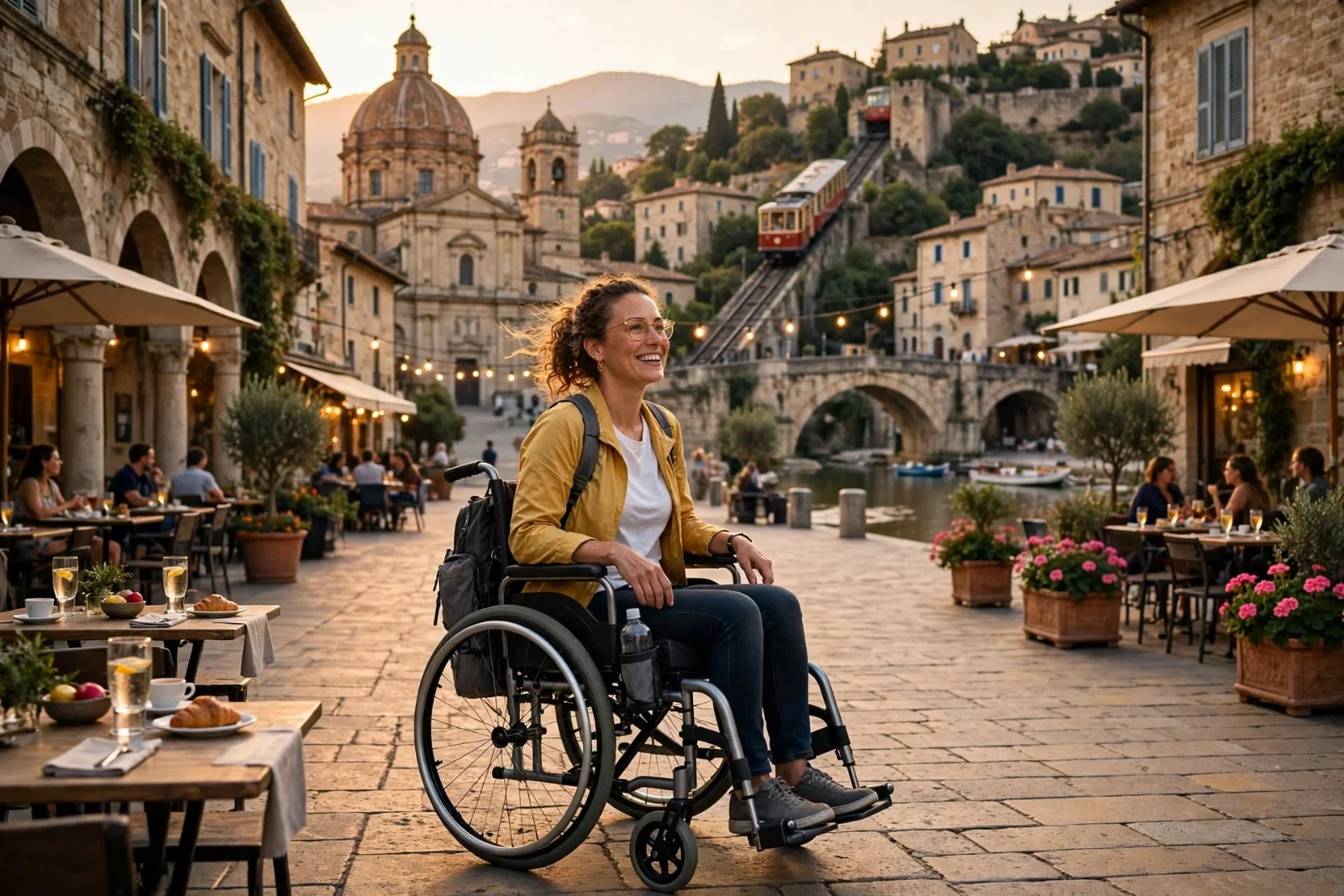
Is Europe wheelchair accessible? It depends entirely on the city, and often on the exact entrance door you use. Modern transit hubs like London, Berlin, Munich, and Frankfurt offer step-free subways, low-floor buses, and elevator-equipped museums. By contrast, medieval hill towns and walled coastal cities across Italy, Spain, Croatia, Montenegro, and Bosnia mix accessible main squares and funiculars with 20% slopes, narrow 70–85 cm historic lifts, and un-ramped subterranean crypts.
Quick answer: Don't trust blanket "wheelchair accessible" tags on commercial tour platforms, which frequently mean only that a folding chair fits in the tour van's trunk. Below, we have compiled our complete index of 17 European destinations and over 105 individual attractions tested against official municipal accessibility data and real wheelchair traveler reports, grouped by region so you can plan a realistic step-free itinerary.
In this master guide: All 17 Cities Compared · Tuscany & Umbria Hill Towns (6 Cities) · Southern & Northern Italy (3 Cities) · Germany, UK & Spain (5 Cities) · Croatia, Montenegro & Bosnia (3 Cities) · Europe Accessibility FAQ
At a Glance: All 17 European Cities Tested for Wheelchair Access
How to read our city ratings:
🟢 High accessibility: Step-free public transit and major landmarks equipped with modern lifts and ramps.
🟡 Moderate / Mixed accessibility: Flat main squares, funiculars, or side ramps work well, but steep streets, narrow historic lifts, or subterranean steps require route planning.
🟠 Challenging terrain: High concentration of steep gradients, cobblestones, or stepped attractions where only select viewpoints or outer areas work on wheels.
| City | Sights Tested | Wheelchair Accessible? Overall Verdict | Full Sight-by-Sight Guide |
|---|---|---|---|
| London (UK) | 6 Sights | 🟢 High (step-free Elisabeth Line, buses, black cabs & major museums) | London Guide |
| Berlin (Germany) | 6 Sights | 🟢 High (flat terrain, Reichstag lift, Museum Island & Memorials) | Berlin Guide |
| Munich (Germany) | 6 Sights | 🟢 High (flat Marienplatz, Residenz lifts, BMW Welt & English Garden) | Munich Guide |
| Frankfurt (Germany) | 6 Sights | 🟢 High (Römerberg, Main Kai riverfront, Museumsufer & Main Tower lift) | Frankfurt Guide |
| Orvieto (Italy) | 5 Sights | 🟡 Surface yes (step-free Funicular, Corso Cavour & Duomo side ramp; caves no) | Orvieto Guide |
| Bergamo (Italy) | 8 Sights | 🟡 Good with limits (both funiculars & Rocca park work; 75 cm tower lift) | Bergamo Guide |
| Perugia (Italy) | 5 Sights | 🟡 Good on the ridge (Minimetro, Pincetto lifts, flat Corso Vannucci & Galleria Nazionale) | Perugia Guide |
| Siena (Italy) | 7 Sights | 🟡 Mixed (Duomo left ramp, Pinacoteca lifts & 70 cm Museo Civico lift; steep hills) | Siena Guide |
| Assisi (Italy) | 5 Sights | 🟡 Mixed (Santa Maria degli Angeli 8% ramp & Lower St Francis 11% ramp; 21% hills) | Assisi Guide |
| San Gimignano (Italy) | 7 Sights | 🟡 Mixed (main squares & select ground floors reachable; medieval towers have steps) | San Gimignano Guide |
| Montepulciano (Italy) | 7 Sights | 🟠 Steep ridge (Piazza Grande reachable by car/ZTL; wine cellars & towers vary) | Montepulciano Guide |
| Alberobello (Italy) | 5 Sights | 🟡 Mixed (Trullo Sovrano ramp & Belvedere flat; Rione Monti slopes 8–12%) | Alberobello Guide |
| Matera (Italy) | 8 Sights | 🟡 Piano & Cathedral yes (side gate + lift); Sassi cave houses & cistern have steps | Matera Guide |
| Ronda (Spain) | 5 Sights | 🟡 Mixed (Puente Nuevo viewpoint & Bullring ground floor work; gorge trails stepped) | Ronda Guide |
| Trogir (Croatia) | 7 Sights | 🟡 Waterfront yes (flat Riva Promenade & Town Museum ramp; fortress has VR only) | Trogir Guide |
| Kotor (Montenegro) | 7 Sights | 🟡 Ground level only (Sea Gate square & Maritime Museum lift; ramparts have 1,350 steps) | Kotor Guide |
| Mostar (Bosnia) | 7 Sights | 🟠 Challenging (view Stari Most from Lucki Most; cobbles require rolling backward) | Mostar Guide |
1. Tuscany & Umbria Hill Towns: 6 Cities Tested
Short answer: Mechanical lifts, funiculars, and ZTL disabled parking permits make Umbria and Tuscany's hilltop centers far more reachable than they look from the valley floor, provided you know which church doors have ramps and which elevator doors are under 80 cm wide.
- Orvieto (5 Sights Tested): One of central Italy's easiest cliff towns on the surface. The Funicolare Bracci climbs the 300-meter volcanic cliff step-free to Piazza Cahen, Corso Cavour is gently graded, and the Duomo di Orvieto provides a right-side ramp at Porta di Postierla. Skip the underground cave tours and the 248 mule steps inside St. Patrick's Well.
- Perugia (5 Sights Tested): Uses the step-free Minimetro light rail and Pincetto elevators to reach the hilltop ridge, where Corso Vannucci and Piazza IV Novembre are flat and the Galleria Nazionale dell'Umbria has full elevator access.
- Assisi (5 Sights Tested): In the flat valley 400 meters from the rail station, the Basilica of Santa Maria degli Angeli is completely step-free via a 540 cm ramp (8% slope). Up on Mount Subasio, the Lower Basilica of St Francis has an 11% ramp and an 85 x 120 cm lift to the Tomb, and Santa Chiara's nave has a left-side ramp, but avoid pushing manually up the 21% outdoor hill to the Upper Basilica.
- Siena (7 Sights Tested): Siena Cathedral and the Piccolomini Library are accessible via a left-side ramp, the Pinacoteca Nazionale has an elevator and stairlifts, and the Museo Civico offers a 70 cm elevator plus 3 free narrow loaner wheelchairs. Skip the Duomo Crypt and Baptistery stairs.
- San Gimignano (7 Sights Tested): See our sight-by-sight test of how to reach the medieval tower squares, where ramps exist, and which historic interiors are blocked by steps.
- Montepulciano (7 Sights Tested): Built along a steep limestone ridge (Il Corso), Montepulciano works best when you drive or take a taxi directly up to flat Piazza Grande using a disabled permit rather than pushing uphill from the lower gates.
2. Southern & Northern Italy: Matera, Alberobello & Bergamo
Short answer: From Lombardy's Venetian walls to Puglia's stone trulli and Basilicata's cave districts, flat upper towns and funiculars contrast sharply with stepped historic interiors.
- Bergamo (8 Sights Tested): Both the Città Alta funicular and the San Vigilio funicular are wheelchair accessible, Piazza Vecchia is flat, and the Campanone civic tower has a lift (with a narrow 75 cm entry door).
- Matera (8 Sights Tested): The upper town (the Piano) and Via Duomo are flat, Matera Cathedral has a step-free side gate on Via Riscatto with an interior platform lift, and Sasso Barisano has one resurfaced main road. However, Palombaro Lungo and the Casa Grotta cave-house museums are blocked by stairs (Casalnuovo's 2019 adaptation is for blind and deaf visitors, not wheelchairs).
- Alberobello (5 Sights Tested): The Belvedere Santa Lucia terrace, Piazza del Popolo, and Trullo Sovrano (via a removable entrance ramp and 90 cm doors) are accessible, while the iconic Rione Monti trulli district climbs at an 8% to 12% slope with stepped shop thresholds.
3. Germany, the UK & Spain: London, Berlin, Munich, Frankfurt & Ronda
Short answer: Western Europe's major capitals and financial hubs deliver the highest rate of independent step-free access in our series, while Spain's dramatic gorge town of Ronda rewards focusing on cliff-edge promenades and the bullring's ground floor.
- London (6 Sights Tested): Backed by 100% wheelchair-accessible black cabs, step-free buses, and the Elizabeth Line, London's headline sights provide documented step-free routes, including the British Museum, Tower of London (ground level and Crown Jewels), and London Eye.
- Berlin (6 Sights Tested): Wide, flat sidewalks and elevator-equipped U-Bahn/S-Bahn stations connect the Reichstag dome lift, Brandenburg Gate, Holocaust Memorial, and Museum Island.
- Munich (6 Sights Tested): Flat pedestrianized zones around Marienplatz and Viktualienmarkt pair with step-free access at the Munich Residenz, BMW Welt, and Nymphenburg Palace grounds.
- Frankfurt (6 Sights Tested): Rebuilt after WWII with modern infrastructure, Frankfurt offers smooth access along the Main riverfront, Museumsufer galleries, Palmengarten, and the Main Tower observation lift.
- Ronda (5 Sights Tested): You can roll across the dramatic Puente Nuevo bridge, enjoy the flat Alameda del Tajo cliff promenade, and visit the ground level of the Plaza de Toros bullring, while skipping the steep gorge trails and stepped Arab Baths.
4. Croatia, Montenegro & Bosnia: Trogir, Kotor & Mostar
Short answer: Along the Adriatic coast, flat waterfront promenades in Trogir and ground-level squares in Kotor offer smooth rolling, whereas inland Herzegovina's cobbled river gorges in Mostar require a strong companion and careful skepticism toward tour-operator labels.
- Trogir (7 Sights Tested): Located just 5 km from Split Airport on a flat islet, Trogir's wide Riva waterfront promenade and main John Paul II Square are completely step-free, and the Trogir Town Museum offers a ground-floor ramp, free disabled entry, and CReAIT assistive tech (while Kamerlengo Fortress provides a 360° VR station in place of its stepped ramparts).
- Kotor (7 Sights Tested): Flat limestone paving inside the Sea Gate lets wheelchair users explore the Square of Arms, St. Tryphon's Cathedral square, and the Maritime Museum (equipped with a lift), while the San Giovanni fortress walls (1,350 steps) are completely off-limits.
- Mostar (7 Sights Tested): Five of Mostar's seven most-marketed sights are not wheelchair accessible, including the steep, ribbed Stari Most bridge arch, Kravice Waterfalls, Blagaj Tekke's four-story interior, and Počitelj's cobbled stairs. View Stari Most step-free from the flat modern Lucki Most bridge nearby, and roll backward with a companion to navigate the Kujundžiluk bazaar and Koski Mehmed Pasha Mosque courtyard.
Europe Wheelchair Accessibility FAQ
Which cities in Europe are the easiest to visit in a wheelchair?
Among the 17 cities we tested, London, Berlin, Munich, and Frankfurt are the easiest for independent wheelchair users thanks to flat central districts, step-free public transit, and modern museum elevators. In Italy, Orvieto, Bergamo, and Perugia stand out among hill towns because funiculars and public lifts handle the steep vertical climbs mechanically.
Which Italian hill towns are actually doable in a wheelchair?
Orvieto (served by a step-free funicular and a gentle central street along Corso Cavour to the ramped Duomo), Perugia (connected by the Minimetro and Pincetto elevators to flat Corso Vannucci), and Bergamo (served by two accessible funiculars) are the most manageable. Siena and Assisi also have ramped cathedrals and lifts, but involve steeper street stretches up to 21%.
Why do tour booking sites label inaccessible European sights as "wheelchair accessible"?
On platforms like Viator, GetYourGuide, and Expedia, operators often check the "wheelchair accessible" box if their minivan or coach can carry a folded wheelchair in the luggage compartment, even when the stops themselves, such as Kravice Waterfalls, Počitelj, Orvieto Underground, or Rocca Maggiore, consist of flights of stairs.
What wheelchair width fits historic European elevators?
While modern European buildings follow an 80 to 90 cm door standard, historic palace and tower retrofits are often narrower. In our audits, we documented a 70 cm lift door at Siena's Museo Civico (which offers 3 narrow loaner chairs), a 75 cm lift door at Bergamo's Campanone tower, and an 85 cm lift door at the Tomb of St Francis in Assisi.
Discussion
No comments yet. Be the first to share your thoughts.
Leave a comment