
Author: Jaziba Luqman
Last updated: October 2026
Jaziba Luqman writes TheDailyFront's wheelchair-accessibility travel series, cross-checking tourism claims against official accessibility databases, operator listings, and traveler accounts.
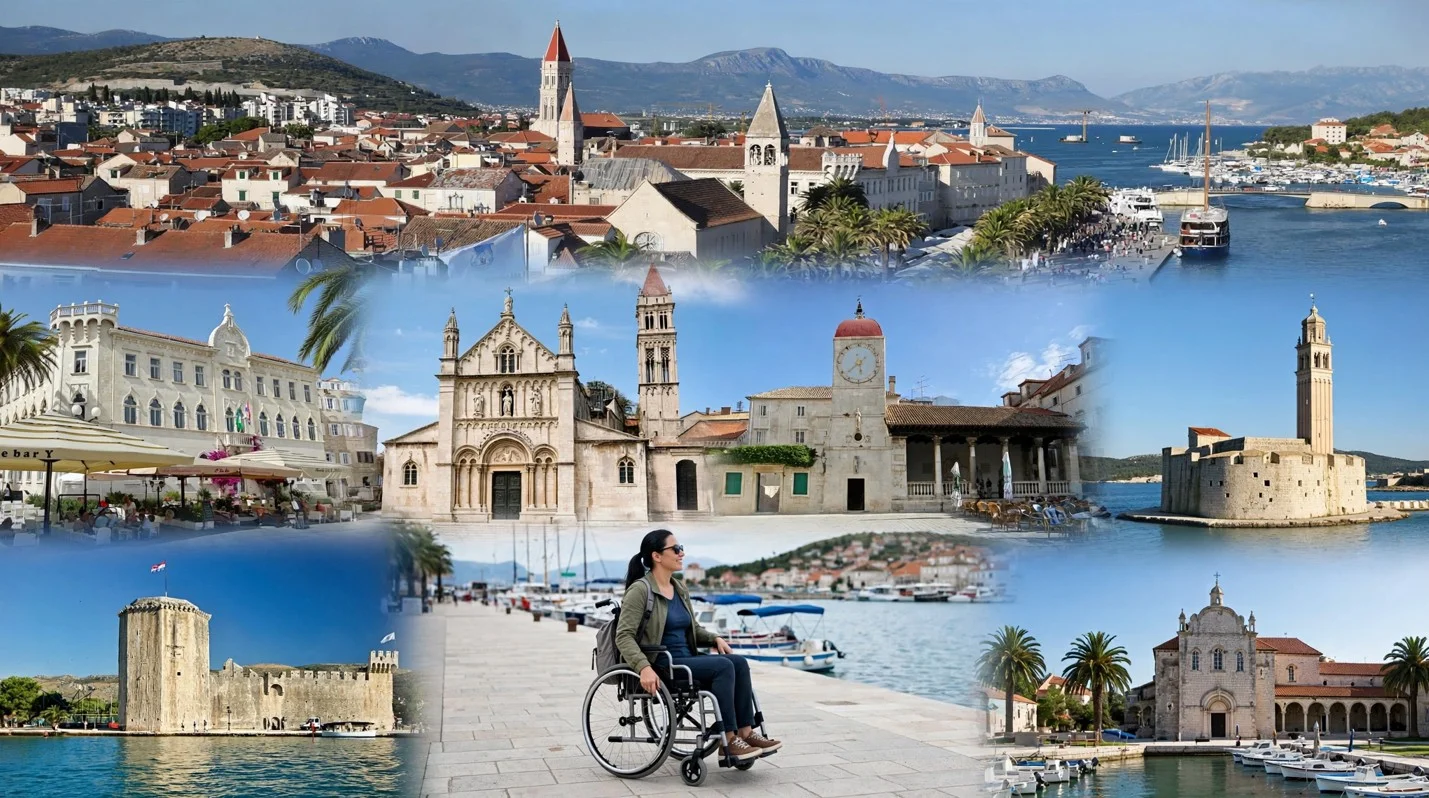
Is Trogir wheelchair accessible? Partly. The wide Riva waterfront promenade and main John Paul II Square are flat and rollable, and the Trogir Town Museum offers a ground-floor ramp, free disabled admission, and CReAIT assistive tools. However, the 15th-century Kamerlengo Fortress, St. Mark's Tower, the 47-meter Cathedral bell tower, and the 3-step raised Town Loggia are blocked by stairs.
Quick answer: Trogir's UNESCO-listed island center sits on flat terrain connected to the mainland by a short bridge, making its outer waterfront much easier to roll along than steep hillside cities. The Riva Promenade is the smoothest wheelchair accessible route on the island, and you can admire Radovan's Portal at the Cathedral of St. Lawrence and the carvings inside the Town Loggia directly from the main square. Use the 360° virtual station at Kamerlengo Fortress rather than climbing its medieval ramparts, and visit the ground floor of the Trogir Town Museum.
In this guide: Riva Promenade · Kamerlengo Fortress · Cathedral of St. Lawrence · Trogir Town Museum · Town Loggia · St. Mark's Tower · Benedictine Monastery & Kairos Relief · Getting Around, Split Airport & Parking · Verdict · Before You Go · FAQ
At a Glance: Is Trogir Wheelchair Accessible? Verdicts by Sight
How to read our verdicts:
🟢 Accessible according to the cited evidence.
🟡 Accessible with limitations or assistance.
🟠 Significant limitations: reachable only in part, or only with substantial help.
🔴 Not wheelchair accessible for the described area.
| Attraction | Marketed As | Wheelchair Accessible? Our Verdict |
|---|---|---|
| Riva Promenade (Waterfront) | Main waterfront sightseeing route | 🟢 Accessible (wide, flat stone promenade with step-free café terraces) |
| Kamerlengo Fortress | CReAIT project: accessible via 360° VR & 3D map | 🟡 Exterior & digital 360° display accessible; 🔴 physical ramparts and interior have stairs |
| Cathedral of St. Lawrence | old-town highlight on walking tours | 🟠 Exterior & Radovan's Portal viewable from square; narrow stepped nave entry and 🔴 47 m tower inaccessible |
| Trogir Town Museum (Garagnin-Fanfogna Palace) | CReAIT project: free disabled entry & tactile/audio tech | 🟡 Ground-floor courtyard and lapidarium accessible via ramp; upper palace floors have stairs |
| Town Loggia (Gradska Loža) | Open-air landmark on main square | 🟡 Fully viewable from flat John Paul II Square; interior pavilion floor sits up 3 stone steps |
| St. Mark's Tower (Kula sv. Marka) | Waterfront Renaissance fortification | 🟡 Flat waterfront park around exterior; 🔴 circular interior requires climbing steps |
| Benedictine Monastery of St. Nicholas (Kairos) | Historic 1064 monastery & art collection | 🟠 Restricted convent access and stone threshold steps at the Kairos exhibition rooms |
Historic coastal towns along the Adriatic often combine flat harborside promenades with centuries-old stone alleys. For comparison, see our Kotor wheelchair accessibility guide and our Mostar step-free breakdown.
While the City of Trogir has invested in digital and sensory inclusion through the EU-funded CReAIT project, commercial walking tours frequently apply blanket accessibility tags without distinguishing between the wide waterfront Riva and the narrow medieval lanes inside the island core. Across the historic center, polished limestone paving slabs, narrow passages, and stepped thresholds determine which buildings you can actually enter on wheels.
Our methodology:
The claim: How local tourism boards, the CReAIT accessibility initiative, and commercial day-trip operators from Split present Trogir's seven major sights.
The reality: We cross-referenced official municipal information from the Trogir Tourist Board, the Trogir Town Museum's CReAIT accessibility documentation, architectural layouts of the John Paul II Square monuments, and verified first-hand accounts from wheelchair travelers.
Surface & Barrier Breakdown Across Trogir's Old Town: Because Trogir sits on a low flat islet between the mainland and Čiovo Island, hills are not the barrier—steps at medieval doorways and uneven stone flags are:
Bars illustrate relative physical barrier severity across Trogir's seven tested sights. Green indicates step-free rolling access; yellow/orange indicates partial access, exterior viewing, or assistive digital workarounds; red indicates un-ramped medieval stairs.
1. Is the Riva Promenade Wheelchair Accessible?
Short answer: Yes. The wide, flat stone waterfront promenade along the southern edge of Trogir's old town is completely step-free and offers the smoothest rolling surface on the island.
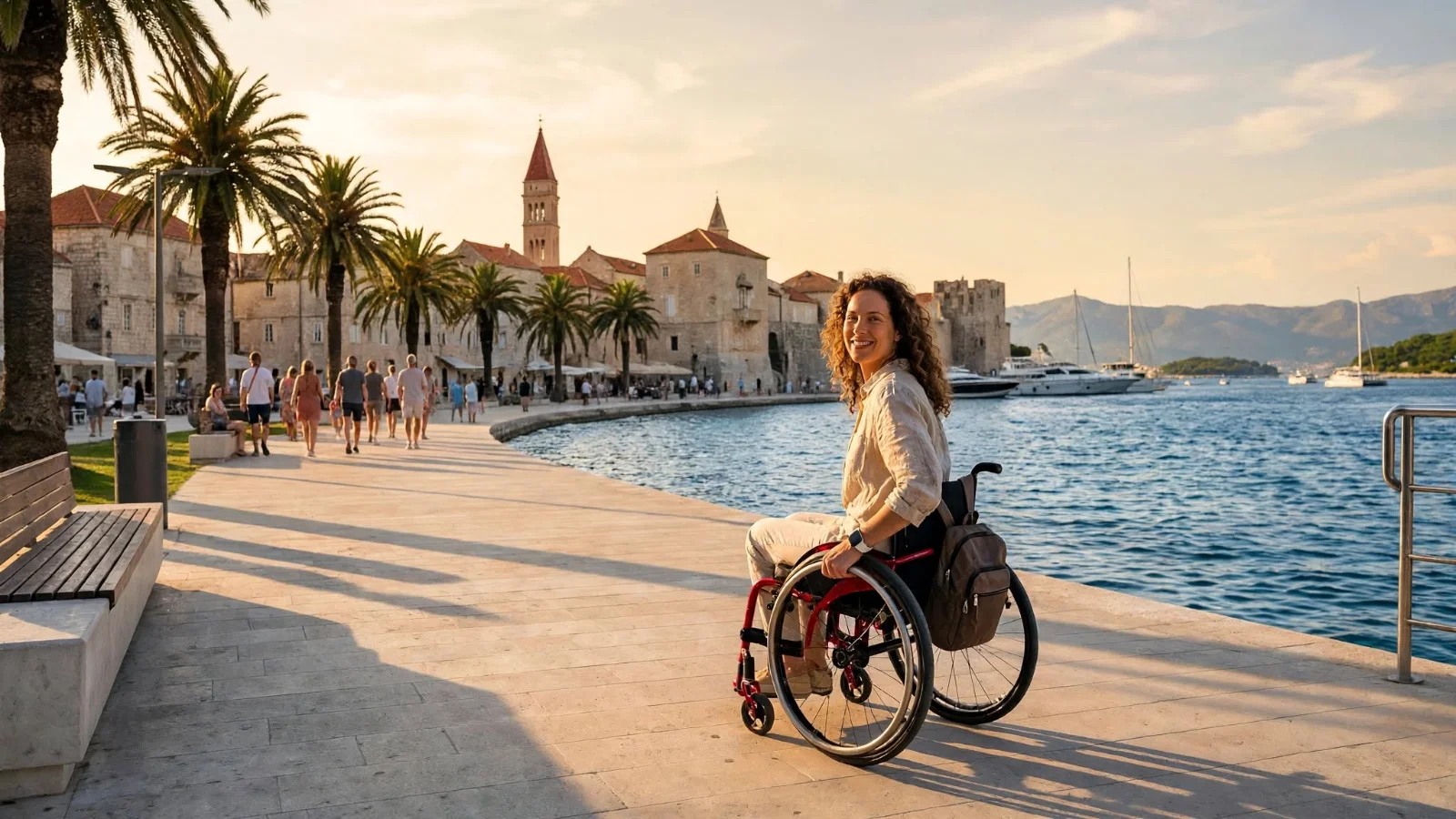
The Claim: Local tourism guides present Trogir's Riva as the social and scenic centerpiece of the island, stretching along the sea channel from the Čiovo bridge to Kamerlengo Fortress.
The Reality: First-hand wheelchair traveler reports confirm that the Riva is by far the easiest and most comfortable place to roll in Trogir, avoiding the tight turns and stepped thresholds of the inner residential alleys.
Access details:
- Smooth waterfront paving: Paved in wide, level stone flags with plenty of maneuvering width around palm trees and benches, the Riva connects the southern Sea Gate (Južna gradska vrata) all the way west to Kamerlengo Fortress and St. Mark's Tower without a single step.
- Verified traveler experience and dining: In a detailed first-hand report, a traveler visiting Trogir with her wheelchair-using father noted that while the inner medieval lanes required extra effort, the Riva itself was "perfect for a wheelchair." Outdoor café and restaurant terraces—including local spots like Restaurant Don Dino—sit at grade along the stone quay, where staff readily clear chairs to create wide wheelchair spaces.
Our verdict:
🟢 Accessible: Wide, flat, and step-free, the Riva Promenade is the best primary route for wheelchair users navigating between the old town gates and the western fortresses.
2. Is Kamerlengo Fortress Wheelchair Accessible?
Short answer: Only from the outside and via digital 360° VR tools. While the flat waterfront park surrounds the outer walls and the CReAIT project provides a 360° virtual tour and 3D tactile model, the 15th-century interior courtyard and battlements are blocked by stairs.
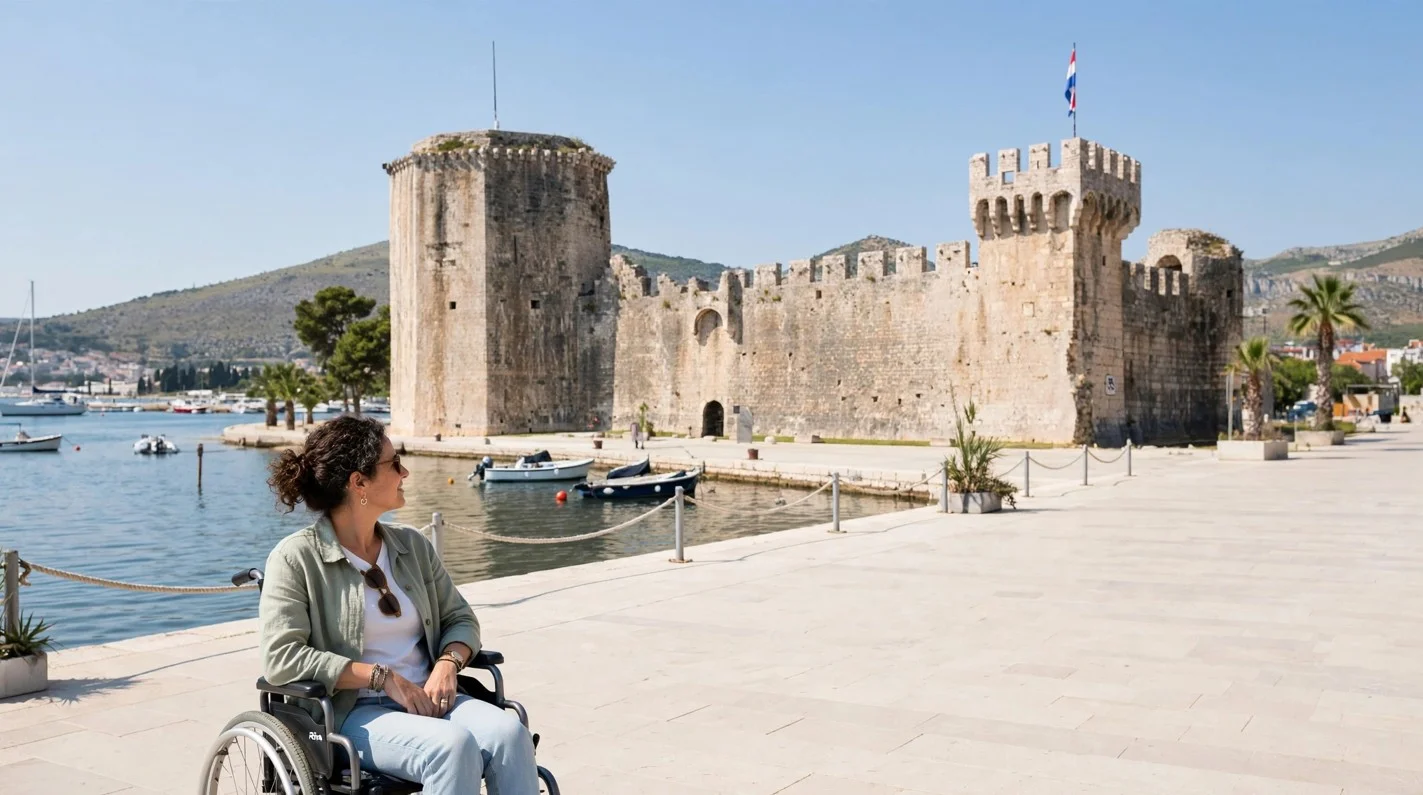
The Claim: Trogir includes Kamerlengo Fortress (Kaštel Kamerlengo) in its municipal CReAIT accessibility initiative, highlighting digital 360° panoramic tools and a 3D tactile map designed for visitors with disabilities.
The Reality: Built by Venetian engineers between 1420 and 1437 as a military stronghold, the physical structure is not step-free inside—which is precisely why the city installed the digital accessibility workaround.
Access details:
- CReAIT 360° Virtual & 3D Experience: Under the CReAIT project, visitors who cannot climb stairs can explore the fortress ramparts and tower views through a panoramic 360° virtual display and an exterior 3D tactile map of the castle complex.
- Physical barriers inside: Entering the historic enclosure and ascending the octagonal keep and curtain walls involves high stone thresholds, uneven grassy courtyard surfaces, and steep, narrow medieval staircases without handrails or lifts. Similar to the historic fortresses in Bergamo, tour listings explicitly mark the physical interior as not wheelchair accessible.
- Exterior promenade route: The flat waterfront walkway wraps cleanly around the base of the fortress walls, allowing effortless exterior photography.
Our verdict:
🟡 Accessible digitally and from the exterior: Roll along the flat Riva to view the 15th-century Venetian walls from outside and use the CReAIT 360° virtual experience, but skip buying an interior climb ticket.
3. Is the Cathedral of St. Lawrence Wheelchair Accessible?
Short answer: Partly from the square and porch, with significant interior barriers. You can roll across flat John Paul II Square to view the exterior and famous 1240 Radovan's Portal, but the nave doorway is narrow and stepped, and the 47-meter bell tower requires steep stairs.
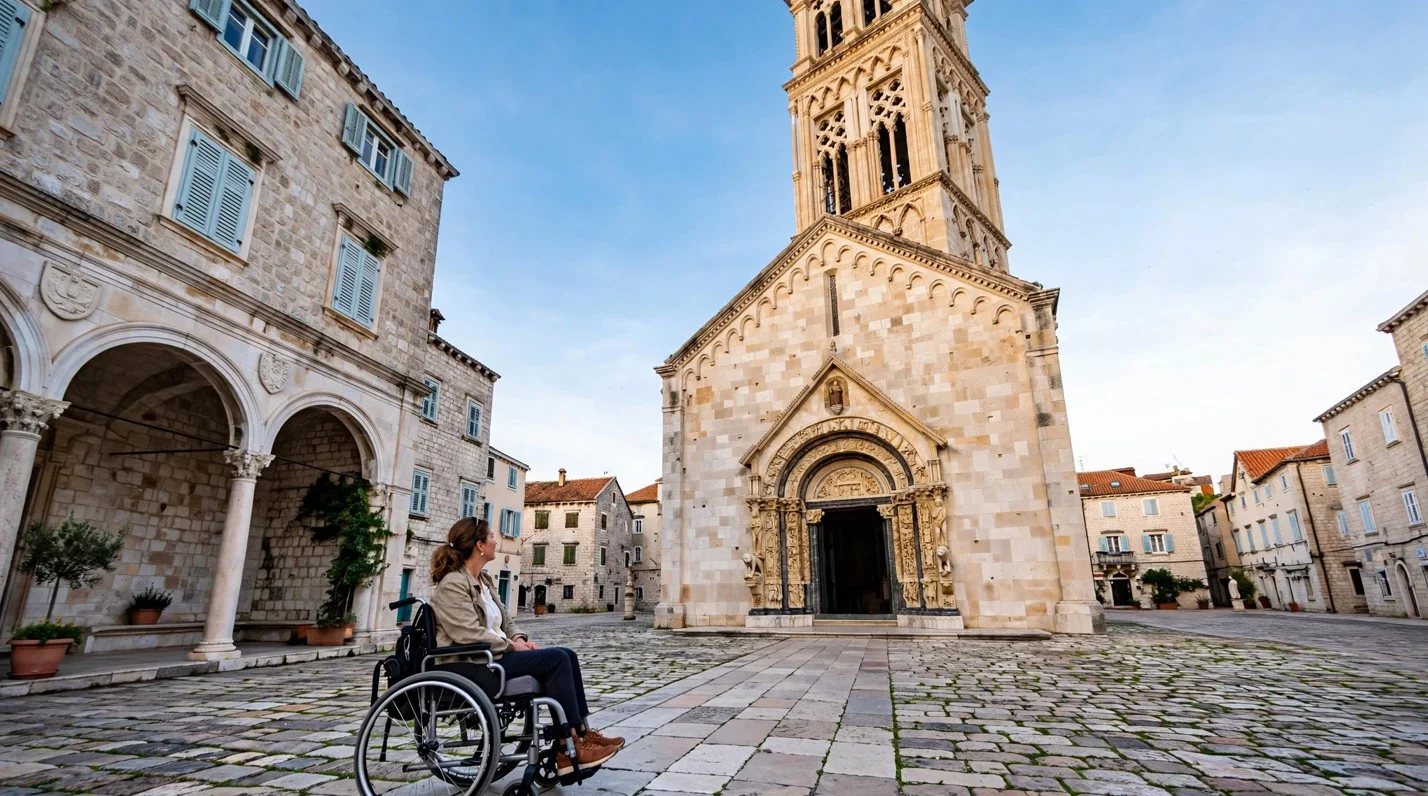
The Claim: Every Trogir sightseeing itinerary centers on the 13th-century Cathedral of St. Lawrence (Katedrala sv. Lovre) and its sculpted Romanesque doorway, Radovan's Portal, often without specifying where steps begin.
The Reality: While the main civic square outside the cathedral is flat and easy to reach from the waterfront, entering the medieval basilica and its bell tower involves architectural barriers.
Access details:
- John Paul II Square (Trg Ivana Pavla II): The main square facing the cathedral is level and paved in large stone slabs, allowing unobstructed exterior views of the Venetian-Gothic facade and rose window.
- Narthex (Porch) & Nave Entrance: The cathedral sits on a raised stone plinth above the square. Reaching the vaulted narthex where Master Radovan's 1240 carved portal stands, as well as passing through the narrow doorway into the three-aisled nave and Chapel of Blessed John of Trogir, involves stone steps and narrow clearances without a permanent wheelchair ramp.
- 47-Meter Bell Tower: Reaching the top of the cathedral bell tower requires climbing narrow, steep stone stairs and metal ladders with no elevator, making it completely inaccessible for visitors with reduced mobility.
Our verdict:
🟠 Significant interior limitations: Admire the cathedral facade from flat John Paul II Square and bring a strong companion if attempting the threshold steps at the porch; the 47-meter bell tower is completely inaccessible.
4. Is the Trogir Town Museum Wheelchair Accessible?
Short answer: Partly. Set in the historic Garagnin-Fanfogna Palace near the North Gate, the museum offers a ground-floor entrance ramp, free admission for disabled visitors and a companion, and CReAIT assistive devices, though upper palace floors require stairs.
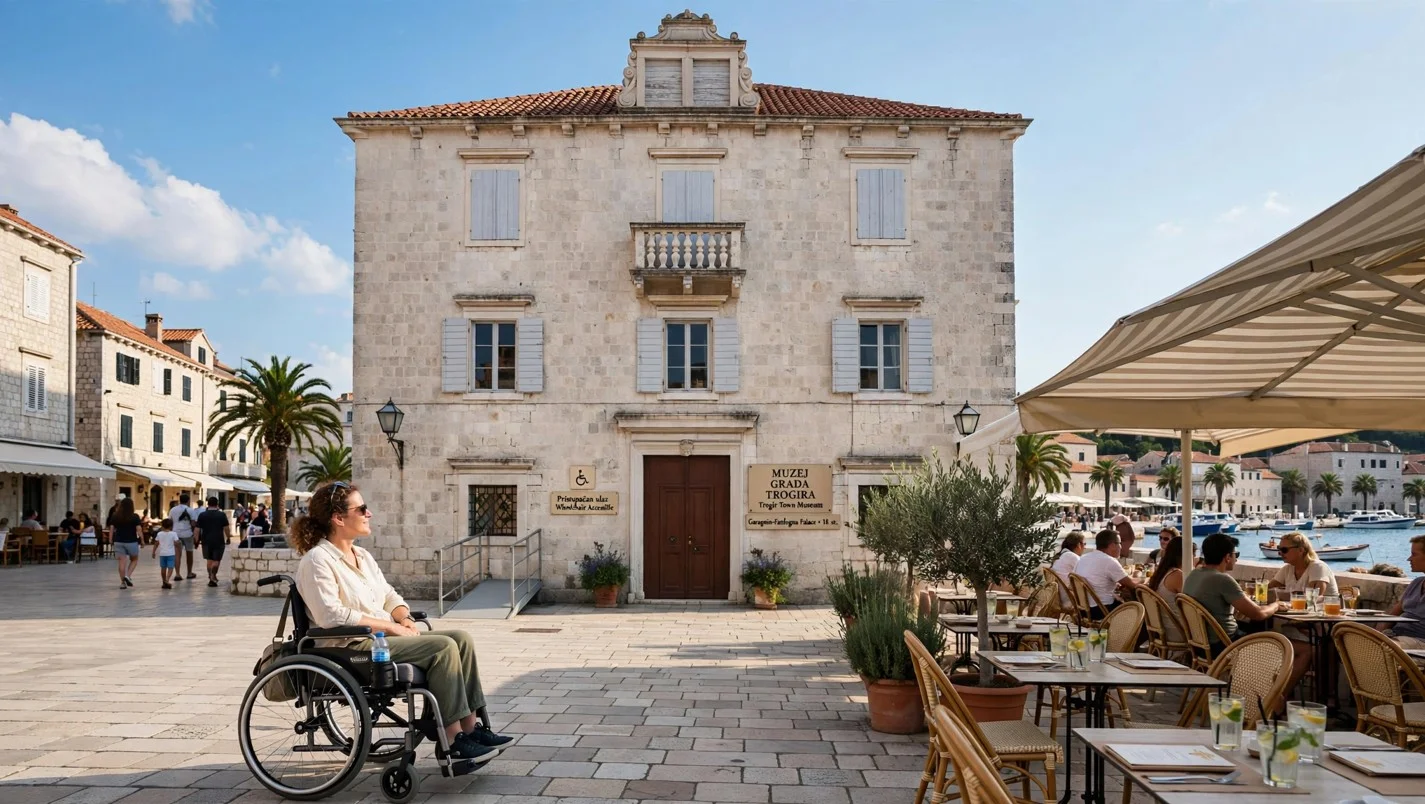
The Claim: Located just inside the mainland North Gate on Gradska ulica, the Trogir Town Museum (Muzej grada Trogira) promotes inclusive access under the CReAIT project, offering free admission to visitors with disabilities and their companions.
The Reality: The museum is housed inside the multi-building Romanesque-Baroque Garagnin-Fanfogna Palace, meaning ground-level spaces and digital assistive tools are readily accessible while upper historic rooms remain constrained by heritage architecture.
Access details:
- Free Admission & CReAIT Assistive Tech: Admission is completely free for visitors with disabilities and an accompanying companion. Through the CReAIT project, the museum provides a tactile and talking pen for selected exhibits and a portable screen with subtitles to make upper-floor and historical content accessible.
- Ground-Floor Courtyard & Gallery vs. Upper Floors: You can reach the museum shortly after crossing the mainland pedestrian bridge at the North Gate (Sjeverna gradska vrata). While the ground-floor courtyard, stone lapidarium, and temporary exhibition gallery (Galerija Cate Dujšin Ribar) sit at street level with ramp support, the historic upper residential salons and library of the 18th-century Garagnin-Fanfogna family are reached via internal palace stairs without a modern passenger elevator.
Our verdict:
🟡 Ground floor and digital tools accessible: Take advantage of the free disabled admission, ground-level courtyard exhibits, and CReAIT talking pen/portable screen, while noting that upper palace floors involve stairs.
5. Is the Town Loggia Wheelchair Accessible?
Short answer: Fully viewable from the flat square, with 3 steps up to the raised floor. Because the 14th-century Town Loggia is an open-sided colonnaded pavilion on John Paul II Square, wheelchair users can view Nikola Firentinac's reliefs from a few feet away without climbing the 3 entry steps.
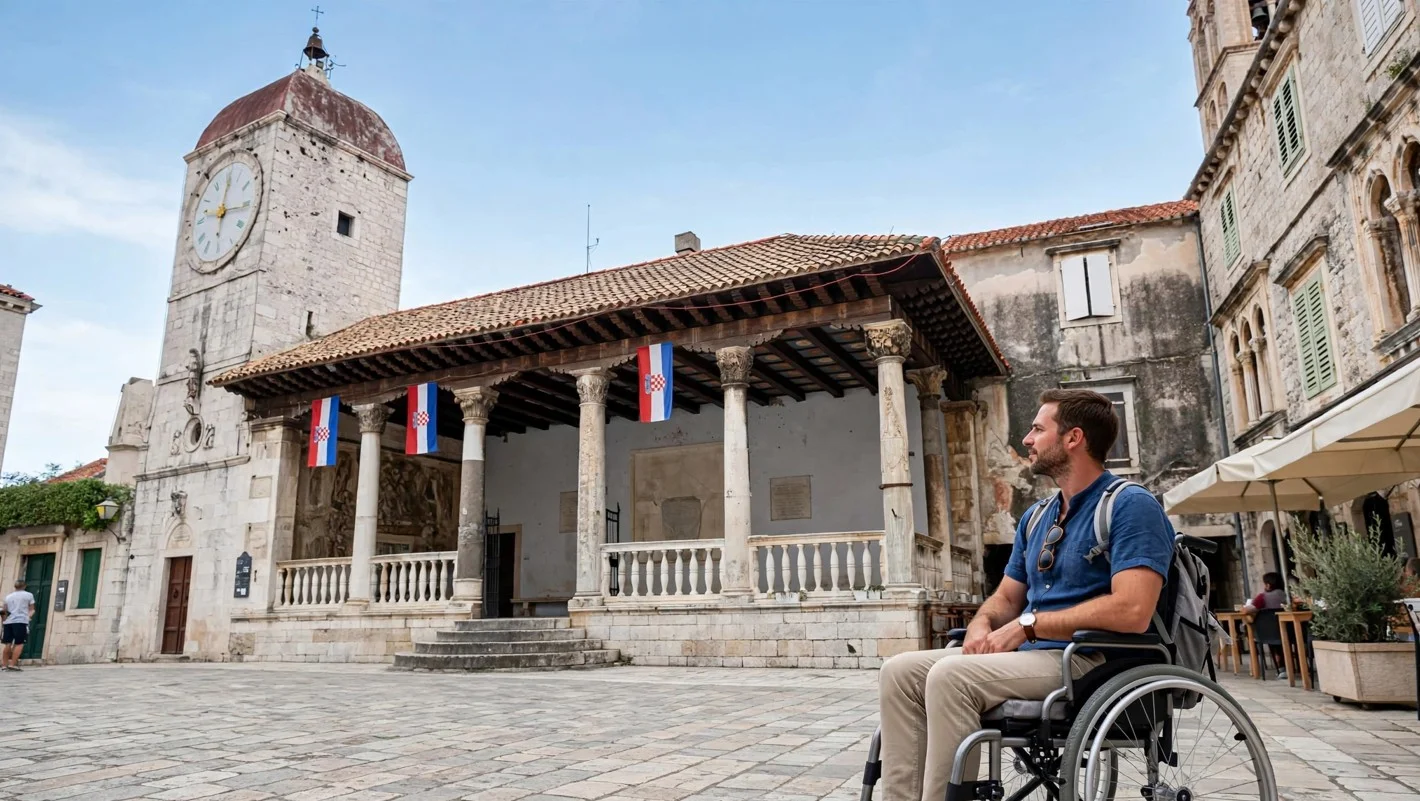
The Claim: Situated directly opposite the Cathedral on John Paul II Square next to the St. Sebastian Clock Tower, the Town Loggia (Gradska loža) is a staple stop on every Trogir old-town tour.
The Reality: Unlike an enclosed museum, the Town Loggia is an open-air Renaissance public courtroom bordered by low stone walls and six classical columns, meaning you do not need to step inside to see its artwork clearly.
Access details:
- 3 stone steps at the entrance: The floor of the loggia sits on a raised stone platform reached up 3 stone steps from the pavement of John Paul II Square, with no ramp installed.
- Unobstructed square-level viewing: Because the pavilion is open on two sides to the main square, wheelchair users can roll right up to the colonnade edge on flat paving to view the stone judges' table, the 1471 Monument to Justice relief by Nikola Firentinac, and the 1606 relief of Ban Petar Berislavić by Ivan Meštrović from just a few meters away.
Our verdict:
🟡 Viewable step-free from the square (3 steps to enter floor): While three steps prevent rolling onto the raised loggia platform itself, its open-air design lets you see the interior sculptures clearly from flat John Paul II Square.
6. Is St. Mark's Tower Wheelchair Accessible?
Short answer: Exterior only. The flat waterfront promenade and park surround the base of the 15th-century circular tower, while entering the interior fortress structure requires climbing stone steps.
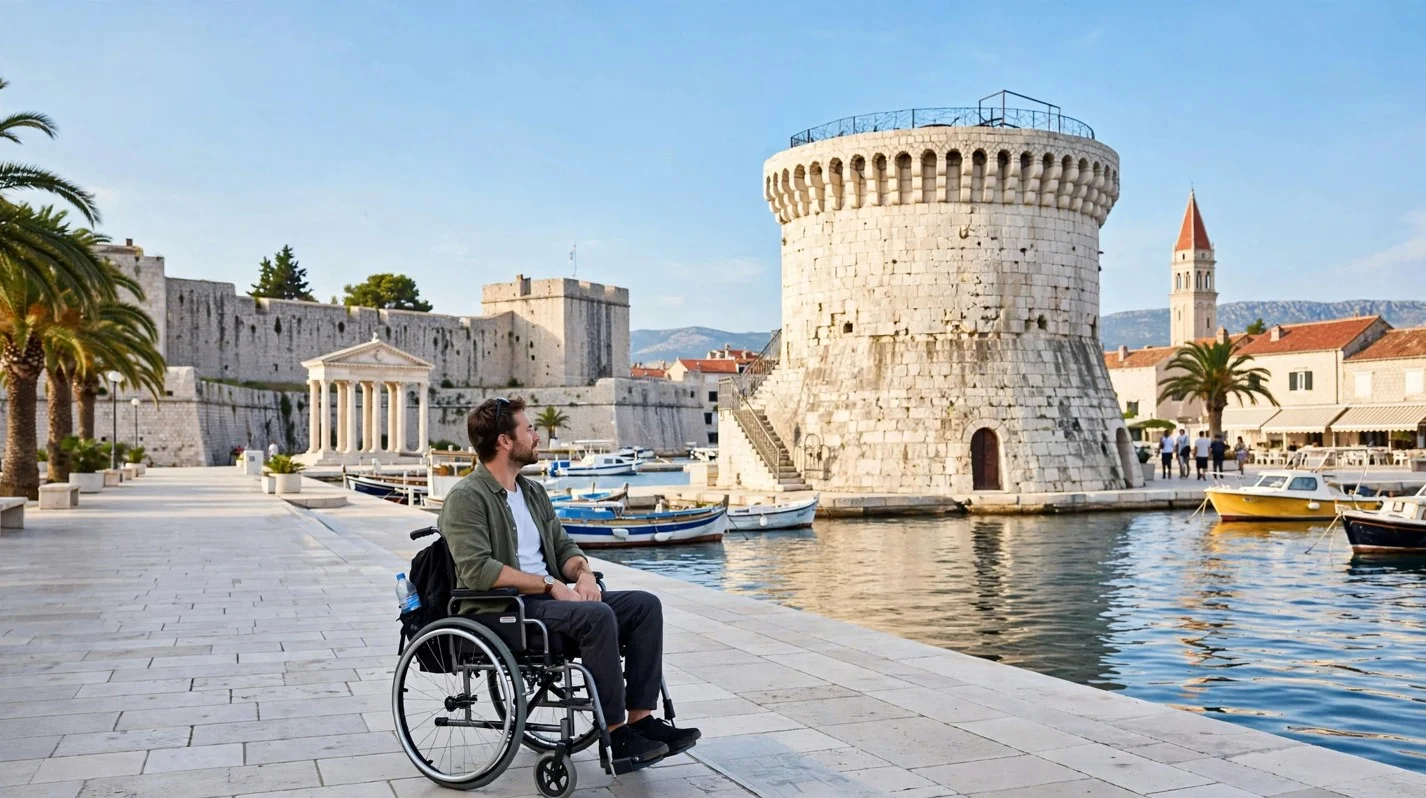
The Claim: Built by the Venetians in the late 15th century to defend the strait between the mainland and the island during Ottoman raids, St. Mark's Tower (Kula sv. Marka) is featured alongside Kamerlengo Fortress on waterfront walks.
The Reality: The surrounding park and seaside walkway are flat and easy to roll across, whereas the historic artillery tower itself was built with defensive stairs.
Access details:
- Flat waterfront approach: Continuing past Kamerlengo Fortress along the western tip of the island, a flat paved walkway leads past the outdoor football pitch (Batarija) right to the base of St. Mark's Tower and the classical marmont Gloriette pavilion.
- Stepped interior: The thick-walled circular tower is only occasionally opened for cultural events or exhibitions, and both its raised doorway and upper cannon terrace are reached by stone steps with no ramp or lift.
Our verdict:
🟡 Accessible exterior waterfront route (interior has steps): Enjoy a smooth, step-free roll around the outside of St. Mark's Tower and the western seafront park, without planning to enter the tower itself.
7. Are the Benedictine Monastery of St. Nicholas and Kairos Relief Wheelchair Accessible?
Short answer: Mostly no. Founded in 1064 next to the southern Sea Gate, the active cloistered monastery restricts public access to a small art collection (housing the 4th-century BC Kairos relief) that involves stone threshold steps and narrow historic passages.
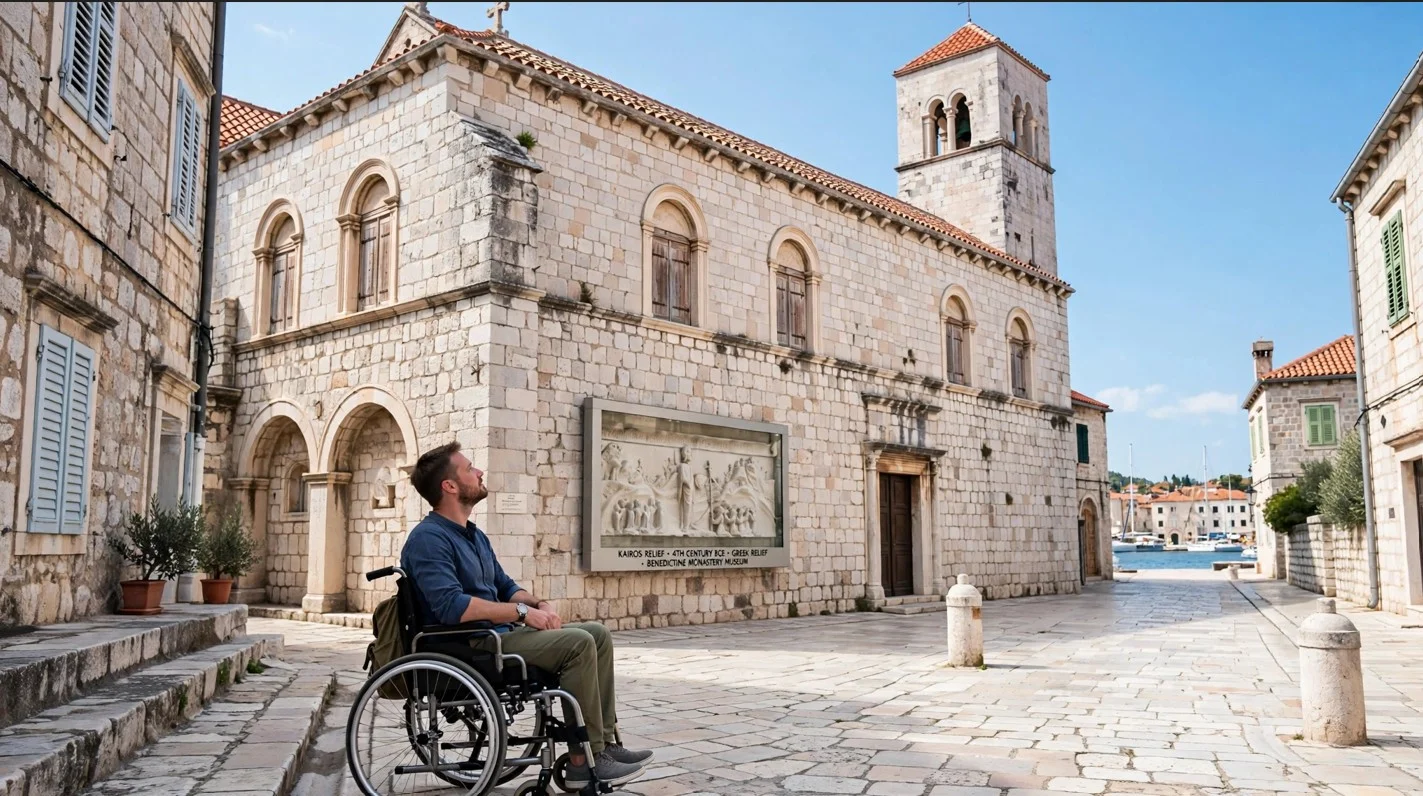
The Claim: Cultural guides highlight the Benedictine Monastery of St. Nicholas (Samostan sv. Nikole) as home to Trogir's most prized ancient artifact: the 4th-century BC Hellenistic marble relief of Kairos, the Greek god of the fleeting opportune moment.
The Reality: Visiting the Kairos Art Collection involves both strict opening rules and medieval architectural barriers.
Access details:
- Location right inside the Sea Gate: The monastery sits on Gradska ulica immediately inside the 16th-century southern Sea Gate (Južna gradska vrata) off the Riva Promenade. Note that the historic Sea Gate arch itself has low stone threshold steps, whereas the northern mainland bridge entrance into Gradska ulica is flatter.
- Cloistered restrictions & exhibition steps: Because the Benedictine nuns maintain an active enclosed community (founded in 1064), the monastery cloister is closed to general tourists, and the small Kairos Art Collection museum opens on limited seasonal hours with stone steps and narrow historic doorways that are not adapted for wheelchairs.
Our verdict:
🟠 Significant limitations: View the exterior monastery church facade and bell tower from Gradska ulica near the Riva, as the enclosed convent and stepped Kairos exhibition rooms are not adapted for wheelchair access.
Getting Around Trogir: Split Airport (5 km), Mainland Bridges, Parking and Boats
Trogir's biggest logistical advantage is its flat island geography and proximity to Split Airport (SPU). Here is what wheelchair travelers need to know about arriving and parking:
- Split Airport (SPU) to Trogir (Only 5 km / 10 Minutes): Split Airport in Kaštela sits just 5 kilometers (about 3 miles) east of Trogir's old town. Pre-booked airport PRM assistance handles aircraft boarding via ambulift and terminal escort, and a short 10-minute taxi or adapted van transfer drops you directly at the mainland bridge to Trogir's historic islet.
- Mainland Wooden Pedestrian Bridge vs. Foša Road Bridge: Trogir's car-free historic islet sits in a narrow channel between the mainland and Čiovo Island. From the mainland parking lots and bus station, you can cross into the old town via the short wooden pedestrian bridge at the North Gate (which has a gentle arch) or roll along the flat sidewalk of the adjacent stone road bridge toward the western Riva waterfront, completely bypassing any gate steps.
- Parking & Disabled Bays (T1 and T2 Car Parks): Because the UNESCO islet is entirely pedestrianized, all vehicles park on the mainland side just north of theFoša channel. The municipal T1 (Fortin / Travarica) and T2 car parks sit 100 to 250 meters from the old town bridge over flat asphalt and include designated disabled parking spaces near the pedestrian crossing.
- Bura Line & Promet Split Buses: Promet Split Bus Line 37 connects Split, Split Airport, and Trogir bus station (located right across the channel from the old town) using low-floor city buses with wheelchair ramps. In summer, the Bura Line passenger boat runs between Split Riva and Trogir Riva, though gangway width and step height depend on tide levels and crew assistance.
So, Is Trogir Wheelchair Accessible? Our Verdict
Partly—and it makes a much easier half-day coastal outing than steep, stepped Dalmatian fortresses, provided you focus on its flat waterfront and main square. Because Trogir is a small, flat island just 5 km from Split Airport, you can roll from the mainland car park onto the wide, palm-lined Riva Promenade without climbing a single hill.
For a smooth step-free itinerary, park at the mainland T1 lot, roll across the Foša bridge onto the western waterfront to view St. Mark's Tower and Kamerlengo Fortress (using the CReAIT 360° VR display instead of climbing the rampart stairs), then continue along the flat Riva Promenade for lunch at a step-free harbor terrace. From there, enter John Paul II Square to view the exterior of the Cathedral of St. Lawrence, Radovan's Portal, and the open-air Town Loggia, and finish at the Trogir Town Museum near the North Gate to enjoy free disabled entry and its ground-floor CReAIT talking-pen exhibits.
Planning more Mediterranean and European trips? Compare our step-free findings in our Siena wheelchair accessibility guide and our Alberobello trulli breakdown.
Before You Go: Trogir Wheelchair Checklist
- Use the Riva Promenade along the southern and western waterfront as your main rolling artery around Trogir islet rather than cutting through the narrow, stepped residential alleys inside the center.
- When entering the old town from the Riva, watch for low threshold steps at the southern Sea Gate (Južna gradska vrata); use the open western route past Kamerlengo Fortress or the northern mainland bridge approach for step-free entry.
- At the Trogir Town Museum (Garagnin-Fanfogna Palace), claim free admission for yourself and a companion at the ticket desk, and ask for the CReAIT tactile/talking pen and portable subtitled screen.
- At Kamerlengo Fortress, use the CReAIT 360° virtual display and 3D map rather than buying a ticket for the stepped 15th-century ramparts.
- On John Paul II Square, roll right up to the open-sided Town Loggia to view Nikola Firentinac's reliefs from the square without climbing its 3 stone steps, and skip the inaccessible 47-meter Cathedral bell tower.
- Arrange any mobility equipment or wheelchair rental in advance through Split or Split Airport providers, as Trogir's tiny island center has no dedicated mobility-scooter rental shop.
Trogir Wheelchair Accessibility FAQ
Is Trogir wheelchair accessible for tourists?
Partly. Trogir's UNESCO-listed old town sits on a flat islet where the wide Riva waterfront promenade and main John Paul II Square are flat and easy to roll across. However, secondary medieval alleys have uneven polished stone slabs, and interiors like Kamerlengo Fortress and the 47-meter Cathedral bell tower have stairs.
Is the Riva Promenade in Trogir wheelchair accessible?
Yes. The Riva waterfront promenade is the most wheelchair-accessible area in Trogir, offering a wide, flat, step-free stone walkway along the sea channel from the Čiovo bridge past the old town to Kamerlengo Fortress. First-hand wheelchair visitors praise its smooth surface and accommodating step-free waterfront restaurants.
Can wheelchair users visit Kamerlengo Fortress and St. Mark's Tower?
You can roll right up to the exterior walls of both 15th-century fortifications along the flat waterfront park, and Kamerlengo Fortress offers a 360° virtual tour and 3D tactile map under the CReAIT accessibility project. However, the physical interiors and rampart walls of both towers require climbing steep stairs.
Is the Cathedral of St. Lawrence in Trogir wheelchair accessible?
Only from the outside and with assistance at the threshold. Wheelchair users can easily roll into flat John Paul II Square to admire the cathedral's exterior and peer toward the 1240 Radovan's Portal, but the raised church entrance is narrow and stepped, and the 47-meter bell tower is completely inaccessible.
Does the Trogir Town Museum have wheelchair access and free entry?
Partly. Housed in the Garagnin-Fanfogna Palace near the North Gate, the Trogir Town Museum offers free admission for disabled visitors and a companion, a ground-floor entrance ramp, and CReAIT assistive tools including a talking pen and subtitled portable screen. Upper palace exhibition floors are reached only by stairs.
Can you see the Town Loggia in Trogir from a wheelchair?
Yes. Although the interior floor of the 14th-century Town Loggia sits up three stone steps without a ramp, the structure is an open-air colonnaded pavilion facing flat John Paul II Square. Wheelchair users can roll right up to the columns to view Nikola Firentinac's 1471 Justice relief clearly from the square.
How do you get from Split Airport to Trogir Old Town in a wheelchair?
Split Airport (SPU) is located only 5 kilometers (a 10-minute drive) from Trogir. You can take a short taxi, pre-booked adapted van, or low-floor Promet Split Bus Line 37 to the Trogir mainland bus station and T1 car park, then roll across the short bridge directly onto the island.
Discussion (1)
Merci beaucoup
Leave a comment