

Author: Jaziba Luqman
Last updated: October 2026
Jaziba Luqman writes TheDailyFront's wheelchair-accessibility travel series, cross-checking tourism claims against official accessibility databases, operator listings, and traveler accounts.
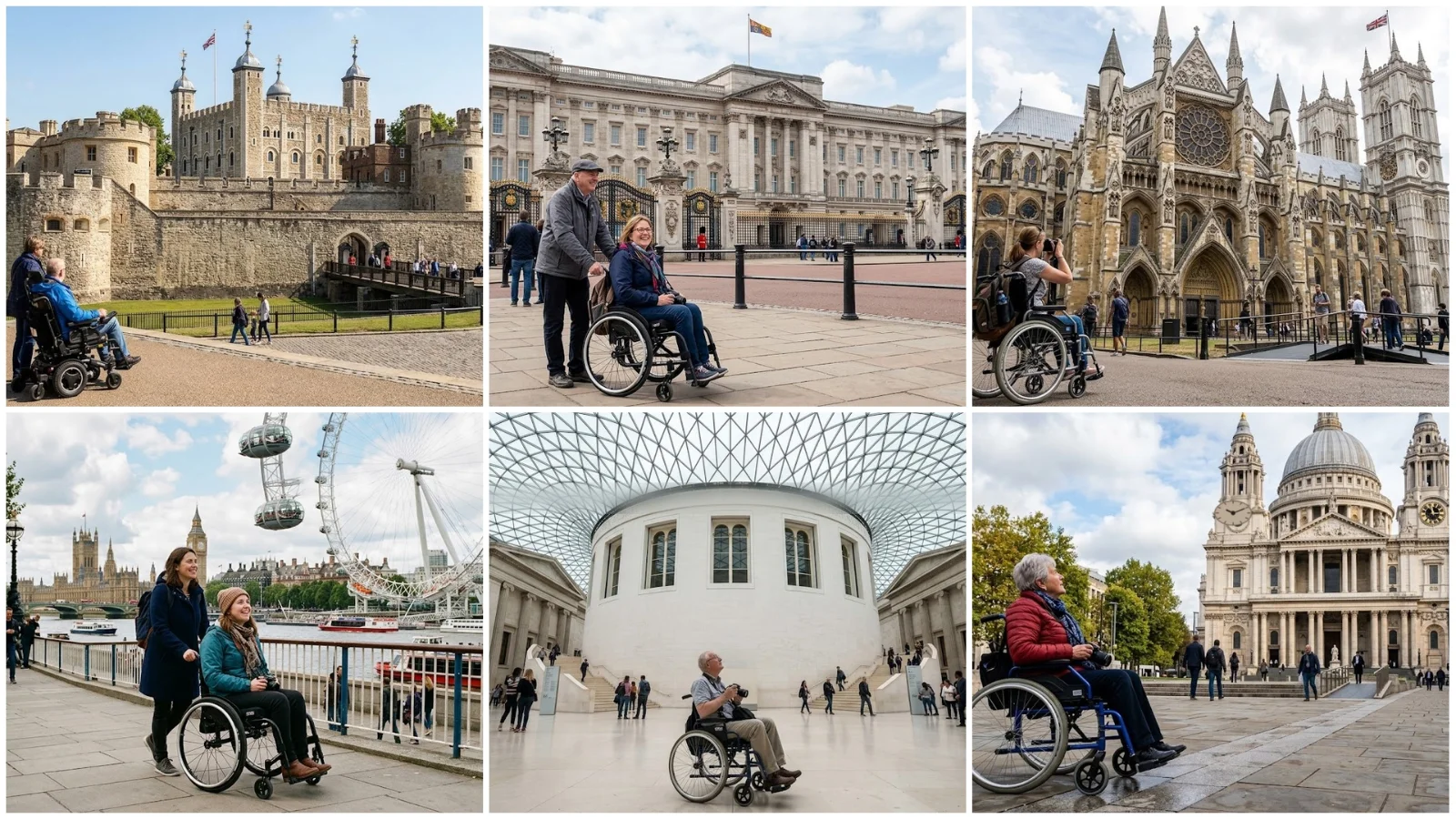
Is London wheelchair accessible? Largely yes. Every London bus route uses low-floor buses with a ramp, all 41 Elizabeth line stations are step-free, and 3 of the 6 sights we tested are step-free for the main visit. The exceptions are historic: the Tower of London's White Tower, Westminster Abbey's Lady Chapel (12 steps) and St Paul's dome galleries (257 steps or more) are out of reach.
Quick answer: Getting around London's major sights is highly manageable. Buckingham Palace, the London Eye and the British Museum are wheelchair accessible with step-free routes, although the Palace and the Eye need advance booking. Historic venues like the Tower of London, Westminster Abbey and St Paul's Cathedral have stair barriers blocking their most famous areas, such as the White Tower or the dome galleries.
In this guide: Tower of London · Buckingham Palace · Westminster Abbey · London Eye · British Museum · St Paul's Cathedral · Getting around, parking and toilets · Verdict · FAQ
At a Glance: Is London Wheelchair Accessible? Verdicts by Sight
How to read our verdicts:
🟢 Accessible according to the cited evidence.
🟡 Accessible with limitations or assistance.
🟠 Significant limitations: reachable only in part, or only with substantial help.
🔴 Not wheelchair accessible for the described area.
| Attraction | Marketed As | Wheelchair Accessible? Our Verdict |
|---|---|---|
| Tower of London | Historic Royal Palaces: wheelchair access is limited | 🟡 Partially accessible: Crown Jewels step-free, but the White Tower lift reaches only the basement shop |
| Buckingham Palace | Royal Collection Trust: accessible, step-free access must be pre-booked | 🟢 Accessible: pre-booked access route with lifts at least 94 cm wide |
| Westminster Abbey | Abbey: open to all, with step-free access | 🟡 Partially accessible: Lady Chapel has 12 steps, plus 3 more into each chapel |
| London Eye | London Eye: wheelchair-friendly, full accessibility throughout | 🟢 Accessible: 2 wheelchairs per pod and 8 per ride, so booking is strongly recommended |
| British Museum | Visit London: lift-assisted access, step-free throughout most of the building | 🟢 Accessible: lifts beside both 12-step entrances; pre-book a loan wheelchair |
| St Paul's Cathedral | St Paul's: ramped North Transept entrance, crypt and quire step-free | 🟡 Partially accessible: dome galleries need 257 to 528 steps |
Some of London's biggest sights deliver exactly what they promise. Others let you in the front door just fine, then leave the best part of the visit behind a staircase.
We checked six of London's most-visited attractions against what each venue's own accessibility page says, then cross-checked those claims against Transport for London (TfL) data, AccessAble access guides, and reports from wheelchair users. Several attractions describe their main visitor route as step-free without stressing that the most iconic part of the visit sits behind stairs, so we name the source and year of each report and flag older ones.
Our methodology:
The claim: What each venue says on its own accessibility page: Historic Royal Palaces for the Tower of London, the Royal Collection Trust for Buckingham Palace, Westminster Abbey, the London Eye and St Paul's Cathedral. For the British Museum we use Visit London's official visitor guide.
The reality: TfL's accessibility pages, AccessAble access guides for the British Museum and the London Eye, and first-hand reports: Scooty (summer 2023), Euan's Guide (March 2015), Tripadvisor (May 2014) and the Sage Traveling surveys, which are undated and carry a 2015 copyright.
Verified step counts and clearances: The figures below come from the venues themselves.
Step bars are scaled to 528 steps; width bars are scaled to 150 cm. The Royal Collection Trust lists the Palace's second lift as 94 cm wide in one section of its page and 110 cm in another, so we use the narrower figure.
Is the Tower of London Wheelchair Accessible?
Short answer: Partly. The Jewel House with the Crown Jewels has level access, but Historic Royal Palaces says wheelchair access across the rest of the Tower is limited by stairs, cobbles and low doorways.

The Claim: Historic Royal Palaces is upfront about this one. Its accessibility page describes the Tower as a historic building with difficult stairs and passageways, including spiral staircases, and says wheelchair access is limited. It also lists a free loan wheelchair and a moving walkway (travelator) beside the Crown Jewels that Palace Hosts will stop on request.
The Reality: The claim holds up. Getting to the Crown Jewels is step-free, but the Sage Traveling survey says the route crosses roughly 200 metres of cobblestones rated only moderately smooth. Historic Royal Palaces lists no lift or ramp access to the Battlements, the Bloody Tower or the Imprisonment at the Tower exhibition, and the only lift in the White Tower runs to the basement shop.
Visitor estimates of the White Tower's stairs vary. One Tripadvisor visitor guessed "perhaps" 100 steps up small, winding staircases, while Sage Traveling counted 40 or more. The Tower publishes no figure, so we give none.
Access details:
- Loan wheelchair: One wheelchair is available free of charge. It cannot be pre-booked and is issued first come, first served by staff on entry.
- Lifts: A staff-operated platform lift serves the Chapel Royal of St Peter ad Vincula (limit of two wheelchair users at a time). The White Tower lift serves the basement shop only, one wheelchair user at a time.
- Toilets: Accessible toilets are in the Brick Tower (behind the Jewel House) and the Cradle Tower. A Changing Places toilet is on the ground floor of the New Armouries, next to the café; café staff lend the RADAR key.
- Getting there: Tower Hill (Underground), London Bridge (Overground) and Tower Gateway (DLR) have lifts to street level. Blue Badge bays are at Tower Hill Coach and Car Park, and taxis and coaches can drop off on Lower Thames Street, a two-minute walk away.
- Tickets: A disabled visitor can bring one carer or companion free of charge.
- Power chairs and scooters: No verified information found on size limits.
Our verdict:
🟡 Partially accessible: honest about its limits, but the historic core of the Tower stays out of reach.
Is Buckingham Palace Wheelchair Accessible?
Short answer: Yes, if you book the step-free route in advance. The Royal Collection Trust says the Palace is accessible, but step-free access must be pre-booked with its Specialist Sales team.

The Claim: The Royal Collection Trust says Buckingham Palace is accessible, but step-free access must be pre-booked by phone on +44 (0)303 123 7324. Visitors who need step-free access enter through a different entrance at the front of the Palace, then join the main visitor route.
The Reality: This is the rare case where the official page and a visitor report agree. The standard route has six steps at the Ambassadors' Entrance, four more into the Grand Entrance, 47 steps on the Grand Staircase and 41 on the Ministers' Staircase; the access route replaces them with lifts. A wheelchair user who visited in summer 2023 reported on Scooty that staff met her at the front gate and radioed for an accessible shuttle, a long golf cart with a ramp. She also described a lift inside the main staircase and said she reached every room on both floors.
Timing matters. The State Rooms Summer Opening runs from July to September, and 90-minute exclusive guided tours run at other times of year. The garden path at the end of the visit is hard gravel, with ten steps down from the West Terrace; buggy transport is offered.
Access details:
- Lifts: The Trust lists lifts 94 cm wide (148 cm deep, 500 kg limit) and a second lift with a 750 kg limit. Its page gives that second lift as 94 cm wide in one section and 110 cm in another, so confirm your chair's width with the Trust.
- Manual wheelchairs: Free to borrow for the visit, but they must be pre-booked.
- Power chairs and scooters: Welcome if they fit the lifts. Class 3 vehicles must set their speed limiter to 4 mph.
- Toilets: Accessible toilets are at the start of the Access Route and at the end of the visit in the garden. A Changing Places toilet is at the Royal Mews.
- Parking: Parking for disability pass holders who need step-free access must be pre-booked with Specialist Sales. The nearest public car parks are Q-Park Victoria (6 disabled bays) and Care Park London Victoria Coach Station (2 disabled bays).
- Getting there: The nearest wheelchair-accessible Underground station is Green Park, and buses 11, 36, 211, C1 and C10 run close to the Royal Mews.
- Tickets: A free access companion ticket is offered for all visits.
Our verdict:
🟢 Accessible: claim confirmed, as long as you book the access route before you go.
Is Westminster Abbey Wheelchair Accessible?
Short answer: Partly. The nave and most of the self-guided route are step-free, but the Lady Chapel (12 steps), the Chapter House, the Pyx Chamber and the side chapels involve steps.

The Claim: The Abbey's own site says it is open to all, with step-free access.
The Reality: The headline is true for the main visit, and the Abbey's page (last reviewed 10 June 2026) lists the exceptions itself. Step-free entry is through the North Door, the Great West Door and the cloister entrance in Dean's Yard; the wheelchair-accessible door is the North Door. The Abbey names these step-free exceptions:
- The Lady Chapel and the tombs of Elizabeth I, Mary I and Mary, Queen of Scots: 12 steps, plus 3 more into each space.
- Side chapels in the North and South Ambulatory: a marked step each.
- The Shrine of St Edward the Confessor: 10 steps and a steep ramp, open only for worship and some guided tours.
- The Cloisters from inside the church: 5 steps from Poets' Corner and 5 from the nave. Leave by the Great West Door and re-enter through Dean's Yard instead.
- The Chapter House: 2, 7 and 1 steps. The Pyx Chamber: a marked step.
An older Sage Traveling survey put the step-free share at about 70% and mentioned staff using a stair climber at Henry VII's chapel. The Abbey's current page does not mention a stair climber, so we rely on neither figure.
Access details:
- Tickets: Free admission for disabled visitors and one essential companion. Timed-entry tickets can be booked online for fast-track entry, and queues can exceed an hour.
- Loan wheelchairs: Manual wheelchairs are free to borrow; ask an Abbey Marshal on arrival.
- Lift: The Queen's Diamond Jubilee Galleries are reached by a lift, and borrowed wheelchairs fit.
- Toilets: Fully accessible toilets are in the Cloisters, reached by a step-free path from the church or through Dean's Yard.
- Getting there: Westminster is the nearest step-free Underground station (0.1 miles), and London Victoria is also step-free (0.7 miles). Blue Badge bays are on Matthew Parker Street, Tothill Street (2 bays) and Old Queen Street (1 bay), and a drop-off space is outside the Great West Door.
- Power chairs and scooters: No verified information found on size limits. Email or call +44 (0)20 7222 5152 for advice before you visit.
Our verdict:
🟡 Partially accessible: the headline is true for the main visit, but a meaningful part of the Abbey's history sits up flights of steps.
Is the London Eye Wheelchair Accessible?
Short answer: Yes. The London Eye allows two wheelchairs per pod and eight on the wheel at any time, and it strongly recommends booking a wheelchair slot.

The Claim: The London Eye's accessibility page calls it a wheelchair-friendly attraction with full accessibility throughout.
The Reality: This one checks out. The boarding ramp and gates take wheelchairs up to 37 inches (about 94 cm) wide, including motorised chairs. Wheelchair slots can sell out at peak times, and on-the-day places depend on availability. The Eye's page says staff will slow the ride if necessary for boarding.
One older complaint no longer applies. A March 2015 Euan's Guide review praised the staff but said the wheelchair booking line cost 10p a minute. The Eye's page now links straight to online wheelchair booking, and we found no current evidence of a premium-rate line.
Access details:
- Capacity: Up to 2 wheelchair users per pod and 8 on the London Eye at any one time.
- Carers: A free carer ticket is available when you buy at least one full-priced ticket, with documentation such as a valid Blue Badge.
- River Cruise: Up to 3 standard-sized wheelchairs per cruise, with ramps for chairs up to 32 inches (about 81 cm) wide.
- Toilets: The Eye's accessibility guide (PDF) includes a map of accessible toilets and entrances.
- Getting there: AccessAble lists Waterloo as the nearest Underground station, where only the Jubilee line is step-free. Westminster has step-free platforms, and Embankment has no step-free access. The Eye has no car park, and it sits inside the Congestion Charge zone.
Our verdict:
🟢 Accessible: largely accurate. Just don't show up without a reservation.
Is the British Museum Wheelchair Accessible?
Short answer: Yes. Lifts sit beside both entrances and serve the main galleries, though a few galleries use steps with platform lifts and staff cannot assist wheelchair users around the museum.

The Claim: Visit London says the British Museum has lift-assisted access at the Montague Place entrance and step-free access throughout most of the building via lifts, and advises calling ahead to hire a wheelchair.
The Reality: The claim holds, with one correction: neither entrance is level. The museum's access guidance, as listed by Access Card, says the Great Russell Street entrance has 12 steps with a handrail, and Montague Place also has 12 steps, with self-operable lifts beside the steps at both. AccessAble's guide adds that the museum cannot provide staff assistance around the building for wheelchair users, and that wheelchairs may not leave the site. In the Parthenon galleries, AccessAble says steps are overcome by platform lifts at either end of Room 18.
A May 2014 Tripadvisor review said lifts reach all floors and that seating is scarce and toilet signs are confusing. That review is more than a decade old, and we found no current seating audit.
Access details:
- Loan wheelchairs: Manual wheelchairs are free but limited and must be pre-booked with at least two working days' notice on +44 (0)20 7323 8181. Collect them at the Great Russell Street entrance.
- Toilets: The nearest accessible toilets for most galleries are in the Great Court.
- Parking: AccessAble lists a car park in the forecourt off Great Russell Street with an unaided accessible route to the entrance. We found no published booking rule, so confirm with the museum first.
- Getting there: AccessAble names King's Cross St Pancras as the nearest step-free Underground station, and all London buses have ramps.
- Power chairs and scooters: No verified information found on size limits.
Our verdict:
🟢 Accessible: the access claim holds up. The comfort of a multi-hour visit is a separate question nobody warns you about.
Is St Paul's Cathedral Wheelchair Accessible?
Short answer: Partly. The cathedral floor, crypt and quire are step-free, but the dome galleries are stairs only: 257 steps to the Whispering Gallery, 376 to the Stone Gallery and 528 to the Golden Gallery.

The Claim: St Paul's own accessibility page recommends the new North Transept entrance, which has ramped access and leads directly onto the cathedral floor. It says the crypt and quire are step-free and that cathedral wheelchairs are available on request.
The Reality: The cathedral's numbers are the ones to trust: 257 steps to the Whispering Gallery, 119 more to the Stone Gallery and 152 more to the Golden Gallery, with no lift. Some third-party guides give slightly different counts, so we use the cathedral's own. The crypt is reached by a lift with usable space of 1,400 mm by 1,300 mm, and the cathedral says it cannot take many Class 3 scooters or some larger Class 2 scooters. The quire is reached by a small electric stairlift with a platform of 1.0 m by 0.76 m. The Triforium, visited on the pre-booked Treasures tour, has no lift and 141 steps.
Access details:
- Tickets: Every disabled visitor and one carer or assistant can request a free sightseeing ticket, booked in advance or on arrival.
- Toilets: Wheelchair-accessible unisex toilets and a Changing Places toilet are in the Crypt. Visitor Experience staff can lend a RADAR key.
- Parking and drop-off: The cathedral points to the City of London's disabled-parking pages for bays nearby. Minibuses with disabled passengers should call +44 (0)20 7246 8350 in advance to arrange a drop-off point.
- Getting there: St Paul's Underground station on the Central line is not step-free. Euan's Guide reviewers and Age UK Mobility name Blackfriars as the nearest step-free Underground station.
Our verdict:
🟡 Partially accessible: the ground floor delivers, but the signature dome experience of St Paul's is out of reach for wheelchair users.
Getting Around London in a Wheelchair: Transport, Parking, Toilets and Chair Limits
Here is what official sources verify for step-free logistics across London:
- Tube, rail and trams: TfL says around a third of Tube stations, half of Overground stations, all DLR stations, all tram stops, most piers and the IFS Cloud Cable Car have step-free access, and all 41 Elizabeth line stations are step-free from street to platform. Some step-free stations still have a gap or step between platform and train: a blue wheelchair symbol on the Tube map means step-free from street to train, and a white symbol means street to platform only.
- Buses and taxis: According to TfL, all bus routes use low-floor vehicles with a ramp and a space for one wheelchair user, and all black cabs have a wheelchair ramp.
- Heathrow: Heathrow asks you to request assistance through your airline at least 48 hours before travel, and says it will still try to help if you forget. Heathrow Express deploys boarding ramps at its airport stations, and the connection to Terminal 4 from the Elizabeth line is a step-free transfer. We found no verified information on London's other airports.
- Driving with a Blue Badge: TfL offers a 100% Congestion Charge discount to holders of a valid Blue Badge from the European Economic Area, once registered for a one-off £10 fee. The discount does not cover the ULEZ charge: Blue Badge holders pay unless the vehicle meets emission standards or has a grace period, such as the disabled tax class grace period running to October 2027. We found no verified information on badges issued outside the EEA.
- Accessible toilets: Verified at all six sights: the Tower of London (plus a Changing Places toilet), Buckingham Palace (plus a Changing Places toilet at the Royal Mews), Westminster Abbey's Cloisters, St Paul's Crypt (plus a Changing Places toilet), the British Museum's Great Court, and the London Eye, whose guide maps them.
- Manual versus power chairs: Manual loan wheelchairs are free at the Tower (not bookable), Westminster Abbey (on arrival), St Paul's (on request), Buckingham Palace and the British Museum (both pre-booked). Power chairs and scooters face published limits at three sights: Buckingham Palace lifts (94 cm wide; Class 3 speed limited to 4 mph), the London Eye (37-inch gate) and St Paul's crypt lift (1,400 mm by 1,300 mm). We found no verified size limits for the Tower, Westminster Abbey or the British Museum.
So, Is London Wheelchair Accessible? Our Verdict
Largely yes, if you plan sight by sight. Line all six up and a pattern shows. The London Eye and the sights with thorough access routes, Buckingham Palace and the British Museum, deliver almost exactly what they promise. The ones with centuries of history in their walls, Westminster Abbey, St Paul's and the Tower of London, make the main ground-level experience accessible and then leave out whichever part is most iconic: the Whispering Gallery, the Lady Chapel, the White Tower's upper floors.
The issue is less about whether the information is technically true and more about what a visitor might reasonably assume from it. Before you plan a trip around this list:
- Book Buckingham Palace's step-free route on +44 (0)303 123 7324, and remember the State Rooms Summer Opening runs from July to September.
- Book a London Eye wheelchair slot, since only eight wheelchairs fit on the wheel at once.
- Pre-book a British Museum loan wheelchair at least two working days ahead.
- If a dome view is the reason you want to visit St Paul's, know in advance that it sits at the top of 257 to 528 steps.
Planning more of Europe? For another capital where step-free sights sit beside stair-only landmarks, compare our Berlin wheelchair accessibility guide and our Frankfurt wheelchair guide. Hilltop and old-town trips are covered in our guides to Siena, Kotor and Matera.
London Wheelchair Accessibility FAQ
Is London wheelchair accessible?
Largely yes. TfL says every bus route uses low-floor buses with a ramp and one wheelchair space, all black cabs have a ramp, and around a third of Tube stations are step-free. Of the six sights we tested, Buckingham Palace, the London Eye and the British Museum rate green, while the Tower of London, Westminster Abbey and St Paul's are partly accessible.
Is the Tower of London wheelchair accessible?
Partly. Historic Royal Palaces says wheelchair access is limited. The Jewel House with the Crown Jewels has level access and a free loan wheelchair is available first come, first served, but the White Tower's only lift goes to the basement shop, and the Battlements and Bloody Tower have no lift or ramp.
Can wheelchair users see the Whispering Gallery at St Paul's Cathedral?
No. St Paul's says the Whispering Gallery (257 steps), Stone Gallery (119 more steps) and Golden Gallery (152 more steps) are reached by stairs only. The cathedral floor, crypt and quire are step-free, entered by the ramped North Transept entrance, and a lift links the floor and the crypt.
Do I need to book wheelchair access in advance for London attractions?
For some, yes. Buckingham Palace requires step-free access to be pre-booked on +44 (0)303 123 7324, and the London Eye strongly recommends a wheelchair slot because only eight wheelchairs fit on the wheel at once. The British Museum asks for two working days' notice for its free loan wheelchairs, while Westminster Abbey and St Paul's lend chairs on request.
Are London Underground stations wheelchair accessible?
Some are. TfL says around a third of Tube stations have step-free access, and so do all 41 Elizabeth line stations, all DLR stations and all tram stops. Some step-free stations still have a gap or step between platform and train, so check the blue and white wheelchair symbols on the Tube map or use TfL's Journey Planner.
Can you drive in London with a Blue Badge?
Yes, with registration. TfL offers a 100% Congestion Charge discount to holders of a valid Blue Badge from the European Economic Area, after registering and paying a one-off fee of 10 pounds. The discount does not cover the ULEZ charge unless your vehicle meets the emission standard or has a grace period, such as the disabled tax class grace period running to October 2027.
How do I get from Heathrow to central London in a wheelchair?
Book assistance through your airline at least 48 hours before flying; Heathrow says it will still try to help if you forget. All 41 Elizabeth line stations are step-free, Heathrow Express staff deploy boarding ramps at its airport stations, and every London bus and black cab has a wheelchair ramp.
Are there accessible toilets at London's main attractions?
Yes. All six sights we tested list accessible toilets: the Tower of London, Buckingham Palace, Westminster Abbey (in the Cloisters), St Paul's (in the Crypt) and the British Museum (in the Great Court), while the London Eye's accessibility guide maps its accessible toilets. The Tower of London and St Paul's also have Changing Places toilets.
Discussion (1)
Such a helpful article
Leave a comment