

Author: Jaziba Luqman
Last updated: October 2026
Jaziba Luqman writes TheDailyFront's wheelchair-accessibility travel series, cross-checking tourism claims against official accessibility databases, operator listings, and traveler accounts.
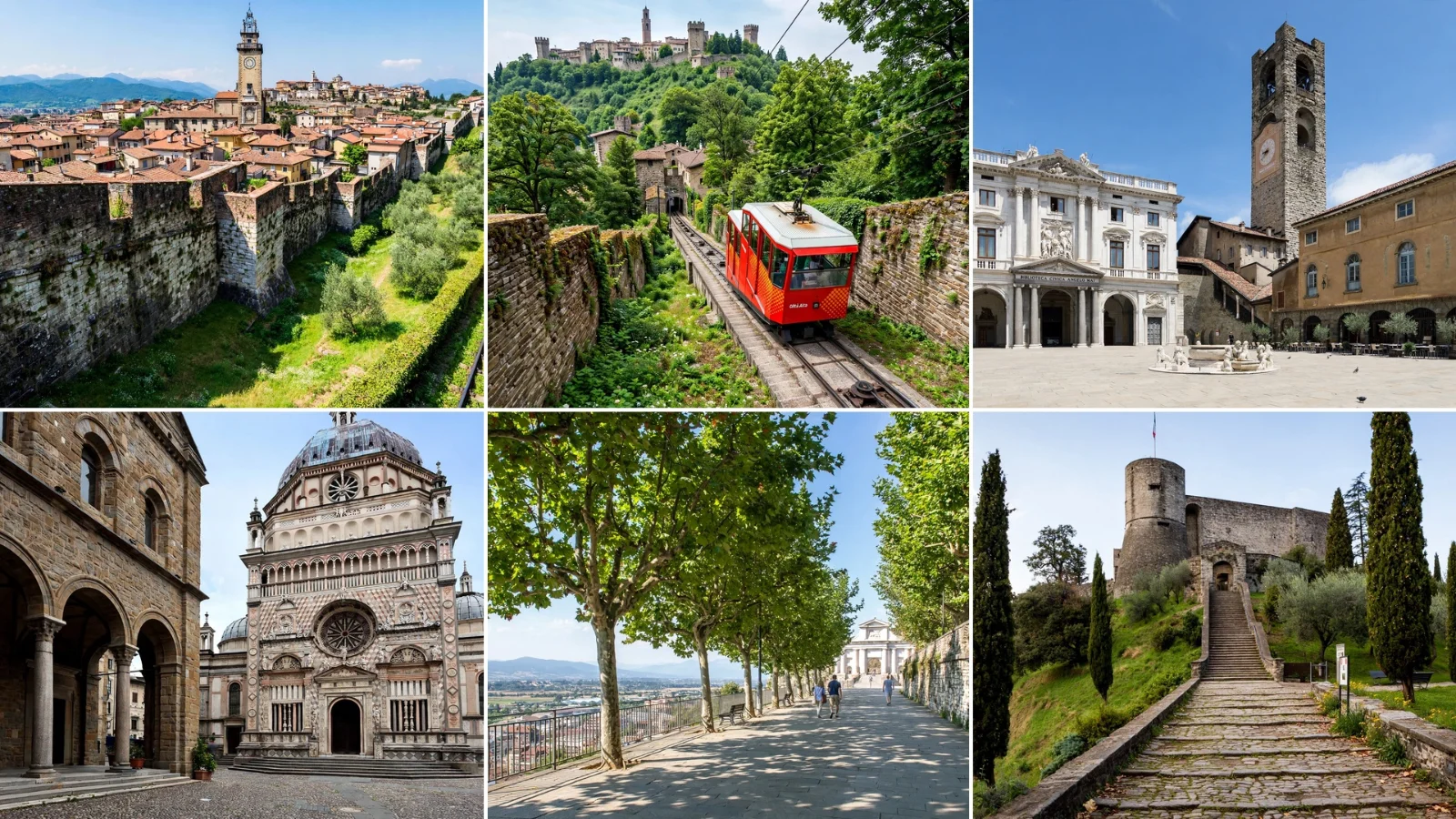
Is Bergamo wheelchair accessible? Partly. A funicular carries you into Città Alta without steps, and an elevator in the Campanone bell tower reaches the first terrace. But only one of the two funicular cabins takes a wheelchair (150 kg limit), and the tower lift door is just 75 cm wide. The Colleoni Chapel and the Rocca museum are blocked by stairs.
Quick answer: Città Bassa is largely flat and easy to roll through from the train station or airport bus stop. In Città Alta, stick to the central spine around Piazza Vecchia and Piazza Duomo: the Torre Civica (Campanone), Palazzo Nuovo, Bergamo Cathedral, and the south-west door of Santa Maria Maggiore are all wheelchair accessible, the Cathedral and the basilica with a companion. Skip the interior of the Colleoni Chapel and the Rocca museum, and check lift door widths before you go if you use a wide chair.
In this guide: Città Alta and San Vigilio Funiculars · Piazza Vecchia, Campanone and Palazzo Nuovo · Santa Maria Maggiore, Duomo and Colleoni Chapel · Venetian Walls and Porta Sant'Agostino · Rocca di Bergamo Museum · Getting around, Airport and Toilets · Verdict · Before you go · FAQ
At a Glance: Is Bergamo Wheelchair Accessible? Verdicts by Sight
How to read our verdicts:
🟢 Accessible according to the cited evidence.
🟡 Accessible with limitations or assistance.
🟠 Significant limitations: reachable only in part, or only with substantial help.
🔴 Not wheelchair accessible for the described area.
| Attraction | Marketed As | Wheelchair Accessible? Our Verdict |
|---|---|---|
| Città Alta Funicular Railway | ATB: accessible with operator assistance | 🟡 Stairlift at upper station; only 1 cabin accessible (max 1 wheelchair, 150 kg limit) |
| San Vigilio Funicular Railway | ATB: equipped with boarding ramp and stairlift | 🟡 Accessible with staff help (max 1 wheelchair, 150 kg limit) |
| Piazza Vecchia and Palazzo Nuovo | Listed on accessible walking tours | 🟢 Central square navigable; Palazzo Nuovo has ramp, 90 cm lift and accessible toilet |
| Torre Civica (Campanone) | Museo delle Storie: accessible by lift to first terrace | 🟡 Glass lift reaches 1st terrace, but lift door is narrow (75 cm) |
| Palazzo della Ragione and Palazzo del Podestà | Mixed across tour listings | 🟡 Podestà has an 80 cm lift; Ragione upper hall requires stairs |
| Basilica of Santa Maria Maggiore | Visit Bergamo: accessible with companion | 🟡 Level south-west side door, approached via a 7 to 8% cobblestone slope |
| Bergamo Cathedral (Duomo) | Viator: accessible via side ramp | 🟡 South side steel ramp (310 cm long, 18% slope) reaches the flat nave; companion advised |
| Colleoni Chapel (Cappella Colleoni) | Included on accessible-tagged city tours; Visit Bergamo: No | 🔴 Not accessible (entrance steps, no ramp) |
| Venetian Walls (Mura Veneziane) | GetYourGuide tours: accessible; Visit Bergamo: No | 🟡 Flat roadside stretches and Porta San Giacomo walkway; Porta Sant'Agostino museum uses a 290 kg stairlift |
| Rocca di Bergamo Museum | Viator: many areas not accessible; Museo delle Storie: not accessible | 🔴 Not accessible (steep uphill approach and entrance stairs; two stairlifts approved at feasibility stage, not yet built) |
Hilltop medieval centers across Italy often pair modern transit links with steep stone lanes. For comparison, see our Perugia wheelchair accessibility guide and our Assisi step-free breakdown.
Booking platforms and official municipal records frequently contradict each other in Bergamo. A private upper-town walking tour on Viator and an upper-town highlights category on GetYourGuide both carry "Wheelchair accessible" tags while listing the Colleoni Chapel, Venetian Walls, and Rocca di Bergamo among their stops. By contrast, a guided lower-town walking tour on Viator is marked "Not wheelchair accessible," even though Città Bassa is the flattest part of the city.
We checked Bergamo's two funiculars and eight sights in and around Città Alta against official municipal technical sheets, museum access rules, public transport regulations, ZTL rules, and a first-hand Italian wheelchair traveler report. Where official evidence confirms step-free access, we cite the exact measurements.
Our methodology:
The claim: How tour operators on Viator and GetYourGuide, along with general tourism brochures, label Bergamo's historic sights.
The reality: Our primary evidence comes from three official local sources: the Visit Bergamo accessibility technical sheets (compiled under Lombardy's regional S.T.A.I. inclusive tourism project), the Museo delle Storie di Bergamo visitor access rules, and ATB Bergamo public transit regulations. For driving, station and airport logistics we also used the pages of the Comune di Bergamo, RFI (the national rail infrastructure manager) and Milan Bergamo Airport. We also cross-checked findings against a first-hand visit report by Pepitosa in Carrozza, an Italian wheelchair travel association.
Verified slopes and lift clearances: Standard ramp guidance (such as the 1:12 US ADA benchmark) recommends a slope of no more than 8%, and standard accessible lift doors usually start at 80 to 90 cm. Here are the exact figures documented on Visit Bergamo's technical sheets and Museo delle Storie's access pages:
Slope bars are scaled to 20%; door-width bars are scaled to 100 cm. Although a 7 to 8% slope meets standard ramp geometry, Visit Bergamo rates the Santa Maria Maggiore approach as yellow (requires companion) because the incline is paved in uneven river cobblestones.
Are the Città Alta and San Vigilio Funiculars Wheelchair Accessible?
Short answer: Yes, with staff help. Only one of the two Città Alta cabins is adapted for wheelchairs, and each trip carries one wheelchair up to a 150 kg loaded weight.
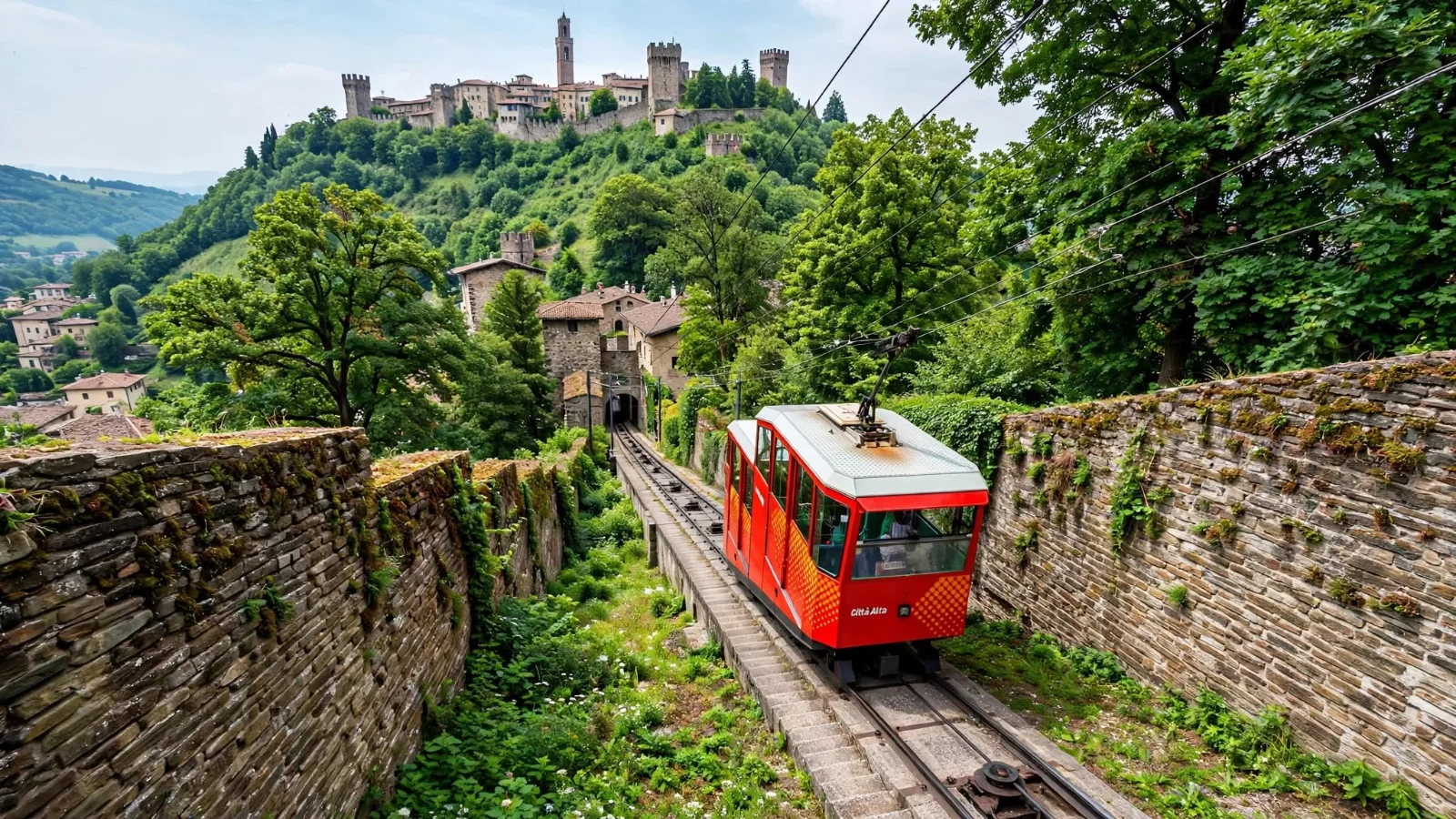
The Claim: ATB Bergamo's English accessibility page states that the funicular stations are equipped with up-and-down lifting devices, tactile maps, and priority access for passengers with disabilities and their companions.
The Reality: The funicular is the best way to avoid the steep road climb into Città Alta, overcoming an 85-meter elevation gain along a 240-meter track that reaches a 52% gradient, according to Visit Bergamo's funicular page. However, it is not a roll-on, roll-off subway car. Both ATB's funicular travel rules and the first-hand report from Pepitosa in Carrozza highlight important operational limits.
Access details:
- Only one accessible cabin: The Città Alta line operates two cars simultaneously, and only one of the two cabins is adapted for wheelchairs (indicated by wheelchair signage at the station).
- Stairlift at the upper station: At the upper terminal in Piazza Mercato delle Scarpe, wheelchair users overcome the station stairs using a platform stairlift (montascale) operated by staff.
- Weight and capacity limits: ATB rules allow a maximum of one wheelchair per trip. Motorized wheelchairs are accepted up to a maximum loaded weight of 150 kg (about 330 lbs), and boarding must be carried out with staff assistance and onboard safety restraints.
- Priority lane: Since May 2025, ATB operates a dedicated priority lane at the lower funicular station for disabled passengers, pregnant women, and pass holders to bypass tourist queues, as reported by BergamoNews.
- San Vigilio Funicular: A second, higher funicular leaves from Colle Aperto (at the far northwestern end of Città Alta) up to San Vigilio hill. According to ATB's Italian accessibility notice, it is also equipped with a boarding ramp, stairlift, and the same 150 kg loaded weight limit.
Our verdict:
🟡 Accessible with staff assistance. Both funiculars work well for manual chairs and compact power chairs under 150 kg total weight, but heavy power-chair users or groups with two wheelchairs will need to travel separately or arrange road transport.
Are Piazza Vecchia, the Campanone and Palazzo Nuovo Wheelchair Accessible?
Short answer: Yes, once you check door widths. The square is rollable and Palazzo Nuovo has a 90 cm lift, but the Campanone lift door is only 75 cm wide.
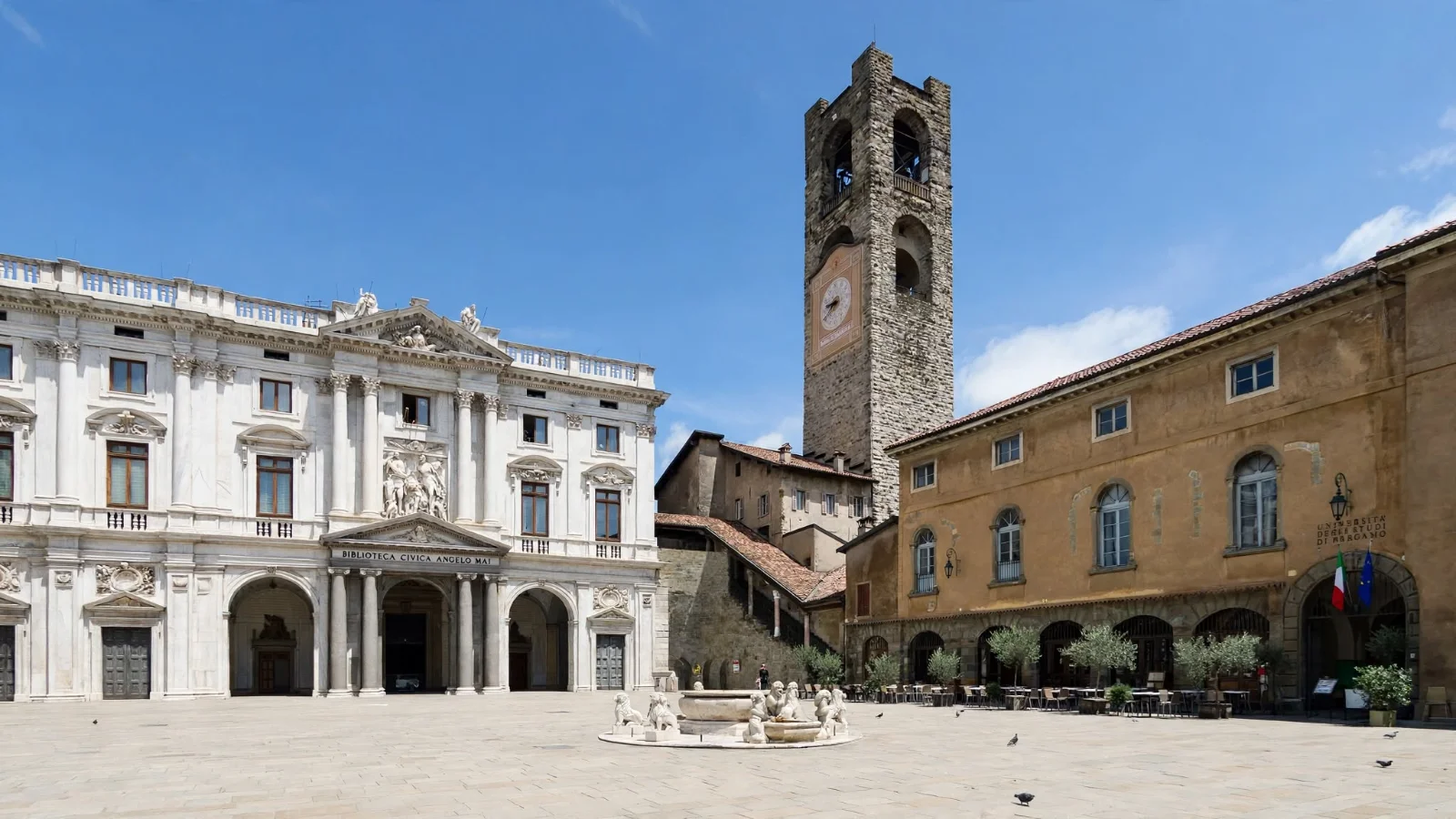
The Claim: Tour platforms list Piazza Vecchia and its civic landmarks as the centerpiece of accessible upper-town itineraries, and Visit Bergamo's page for the Torre Civica (Campanone) notes that visitors can ascend either on foot or by elevator, with free admission for disabled visitors and a companion.
The Reality: From the upper funicular exit at Piazza Mercato delle Scarpe, Via Gombito leads gently uphill to Piazza Vecchia. In her first-hand account, wheelchair user Valentina (Pepitosa in Carrozza) reports that the paving along this main spine is mostly porphyry setts and smooth stone slabs rather than rough cobblestones, making it straightforward to roll across.
For the buildings around the square, Museo delle Storie di Bergamo and Visit Bergamo's technical sheet for Palazzo Nuovo provide exact measurements:
- Torre Civica (Campanone): A glass elevator takes wheelchair users up to the first panoramic terrace, where you can look out over Bergamo Alta without climbing the 230 steps. However, Museo delle Storie specifies that the elevator width is 75 cm (about 29.5 in), so check your wheelchair's width before boarding.
- Palazzo del Podestà: Connected to the Campanone ticket, this museum is listed by Museo delle Storie as accessible via an 80 cm (about 31.5 in) elevator.
- Palazzo della Ragione: The ground-level stone loggia under the arches is open and flat from Piazza Vecchia, but reaching the upper Sala delle Capriate exhibition hall requires climbing the historic outdoor staircase.
- Palazzo Nuovo (Angelo Mai Civic Library): Located on the northeast side of Piazza Vecchia. Visit Bergamo's audit rates it accessible in autonomy: the final porphyry approach has an 8% slope, a ramp at the western end of the portico leads to a threshold-free door, two elevators inside have 90 cm doors (135 x 150 cm cabin, 600 to 900 kg capacity), and there is a fully equipped accessible bathroom on the ground floor.
Our verdict:
🟢 Piazza Vecchia and Palazzo Nuovo: accessible, with verified ramps, wide lifts, and an accessible restroom at Palazzo Nuovo.
🟡 Campanone and Palazzo del Podestà: accessible by elevator, provided your wheelchair fits the 75 cm (Campanone) and 80 cm (Podestà) door widths.
Are Santa Maria Maggiore, the Duomo and the Colleoni Chapel Wheelchair Accessible?
Short answer: Partly. The Cathedral (south-side ramp, 18% slope) and Santa Maria Maggiore (level south-west door) both work with a companion, but the Colleoni Chapel is blocked by entrance steps.
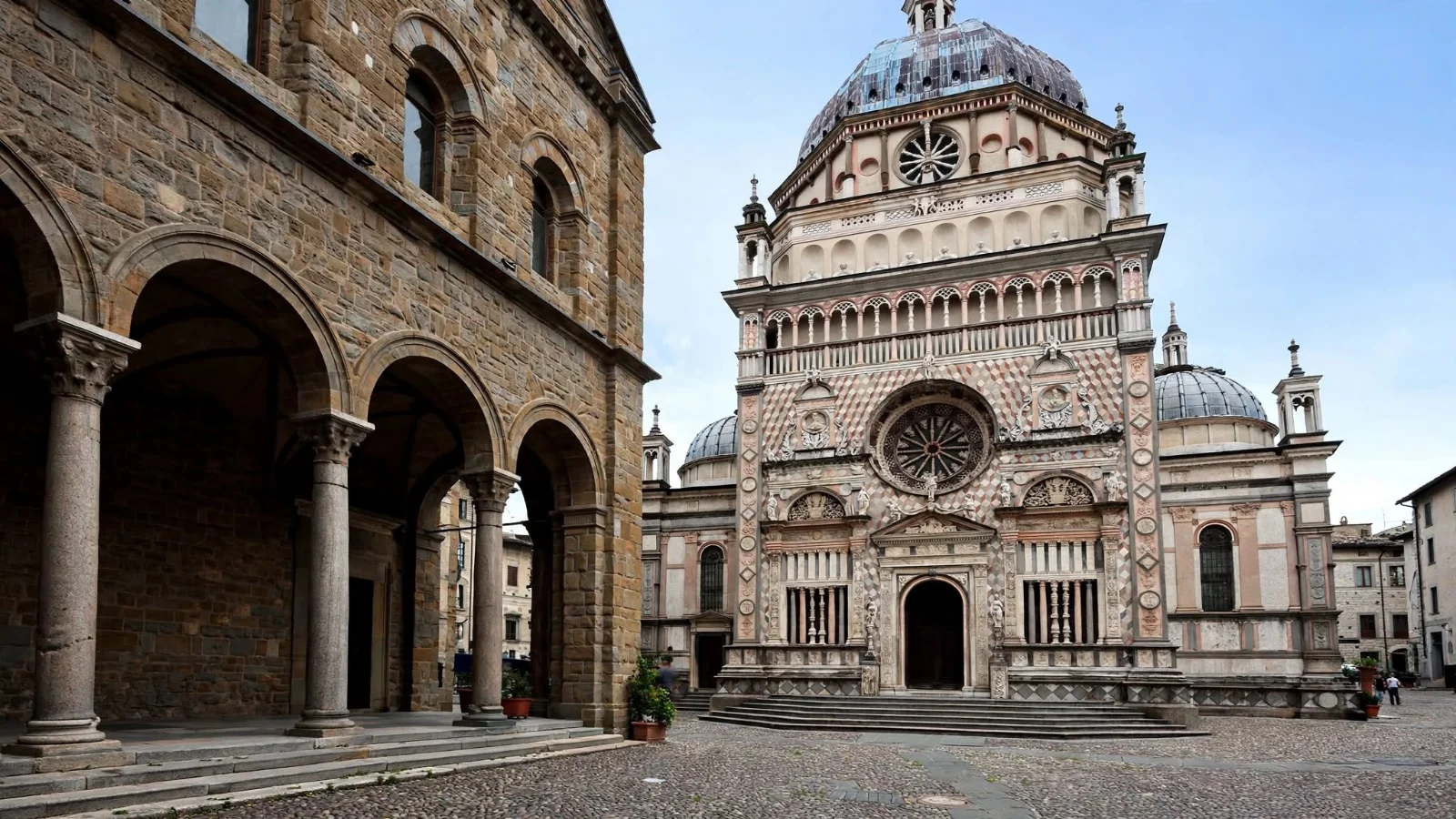
The Claim: Viator's attraction page for Bergamo Cathedral states that the cathedral is wheelchair accessible via a ramp at the south side entrance. Meanwhile, several GetYourGuide and Viator tours tagged "Wheelchair accessible" bundle Santa Maria Maggiore, the Cathedral, and the adjacent Colleoni Chapel into a single stop.
The Reality: Piazza Duomo sits right behind the Palazzo della Ragione arches, but its three famous religious buildings have very different access conditions.
Access details:
- Basilica of Santa Maria Maggiore: The famous northern Red Lion porch on Piazza Duomo has steps. According to Visit Bergamo's technical sheet for the basilica, the only step-free entrance is the south-west secondary portal (Ingresso Sud-Ovest) on Piazza Rosate, which is always open, wide, and level (in piano) at the threshold. However, the pedestrian approach down Via Mario Lupo has a 7 to 8% slope over rough cobblestones (acciottolato), which is why the city rates the basilica as "accessible with a companion." Inside, the nave is flat and step-free, except for the presbytery and choir (3 steps). Admission is free for disabled visitors and a companion, and there are no restrooms inside.
- Bergamo Cathedral (Duomo di Sant'Alessandro): While the front portico steps face Piazza Duomo, Visit Bergamo's technical sheet for the cathedral describes a step-free south side entrance (a secondary gate that is always open) reached by an external steel ramp 310 cm long with an 18% slope. The footpath to that entrance runs downhill at 7 to 8% on stone slabs. Inside, the single nave is flat and accessible, but the presbytery and the Chapel of San Vincenzo (7 steps), the crypt (stairs) and the Chapel of the Crucifix (one 17 cm step) are not, and there are no restrooms. The city rates the cathedral as "accessible with a companion." Note that the Pepitosa in Carrozza blogger skipped it in 2020 thinking it lacked a ramp, so look specifically for the south side entrance.
- Colleoni Chapel (Cappella Colleoni): Despite appearing on accessible-tagged walking tours, Visit Bergamo's official page for Cappella Colleoni explicitly lists motor accessibility as "No." A flight of steps behind the wrought-iron gate blocks wheelchair entry, so you can only admire its inlaid marble facade from the square.
Our verdict:
🟡 Bergamo Cathedral: accessible with a companion via the south side ramp, which climbs at 18%. The nave is flat, but the presbytery and crypt are not reachable.
🟡 Basilica of Santa Maria Maggiore: level entry through the south-west door, but bring a companion for the 7 to 8% cobbled approach slope.
🔴 Colleoni Chapel: not accessible inside due to entrance steps.
Are the Venetian Walls and Porta Sant'Agostino Wheelchair Accessible?
Short answer: Partly. The Viale delle Mura promenade and the Porta Sant'Agostino museum (via 290 kg stairlifts) work, but the underground cannoniere and stepped bastion paths do not.
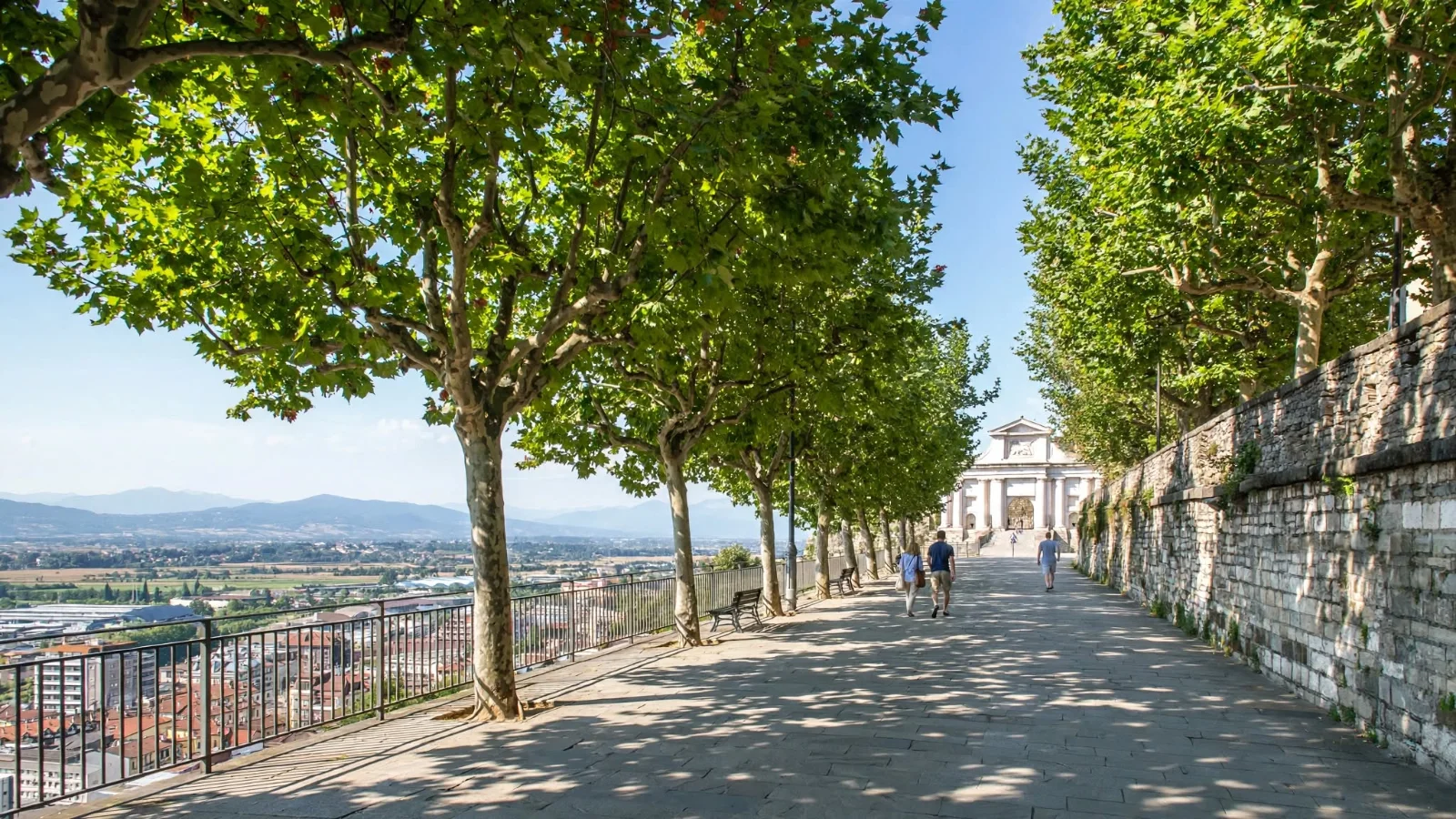
The Claim: Guided walks and tuk-tuk tours along the UNESCO-listed Venetian Walls are widely marketed as easy, step-free experiences, yet Visit Bergamo's main page for Le Mura Veneziane marks motor accessibility as "No."
The Reality: Why do the sources disagree? Because "the Venetian Walls" refers both to the 5-kilometer perimeter road (Viale delle Mura) and to the historic gates, underground gunpowder magazines (cannoniere), and stepped rampart walks.
Access details:
- Viale delle Mura promenade: The paved tree-lined sidewalk running from Colle Aperto along the western and southern walls toward Porta San Giacomo is wide, flat to gently sloped, and offers the best step-free panoramic views over Città Bassa.
- Porta San Giacomo: This iconic white-marble pedestrian gate is fitted with a permanent step-free walkway (passerella) over the entrance bridge, praised by local wheelchair users on BergamoNews, though the stone path climbing from Porta San Giacomo into the upper town is steep.
- Porta Sant'Agostino and Museo delle Mura: According to Visit Bergamo's Porta Sant'Agostino audit and Museo delle Storie, the pedestrian approach from the Line 1 bus stop has a 6% slope. The left side entrance has a 5 cm threshold and a 120 cm double door, and two platform stairlifts (rated to 290 kg) carry visitors to the first-floor exhibition rooms and the basement accessible restroom (90 cm door, 51 cm toilet height with grab bars).
For another example of a UNESCO walled city where roadside viewpoints work better than rampart stairs, see our Kotor wheelchair guide.
Our verdict:
🟡 Partially accessible. The Viale delle Mura sidewalk promenade and Porta Sant'Agostino (via 290 kg platform stairlifts) are accessible, whereas underground cannoniere and stepped bastion paths are not.
Is the Rocca di Bergamo Museum Wheelchair Accessible?
Short answer: No, not at present. A steep uphill approach and entrance staircases block entry, and two stairlifts approved at feasibility stage in September 2026 are not built yet.
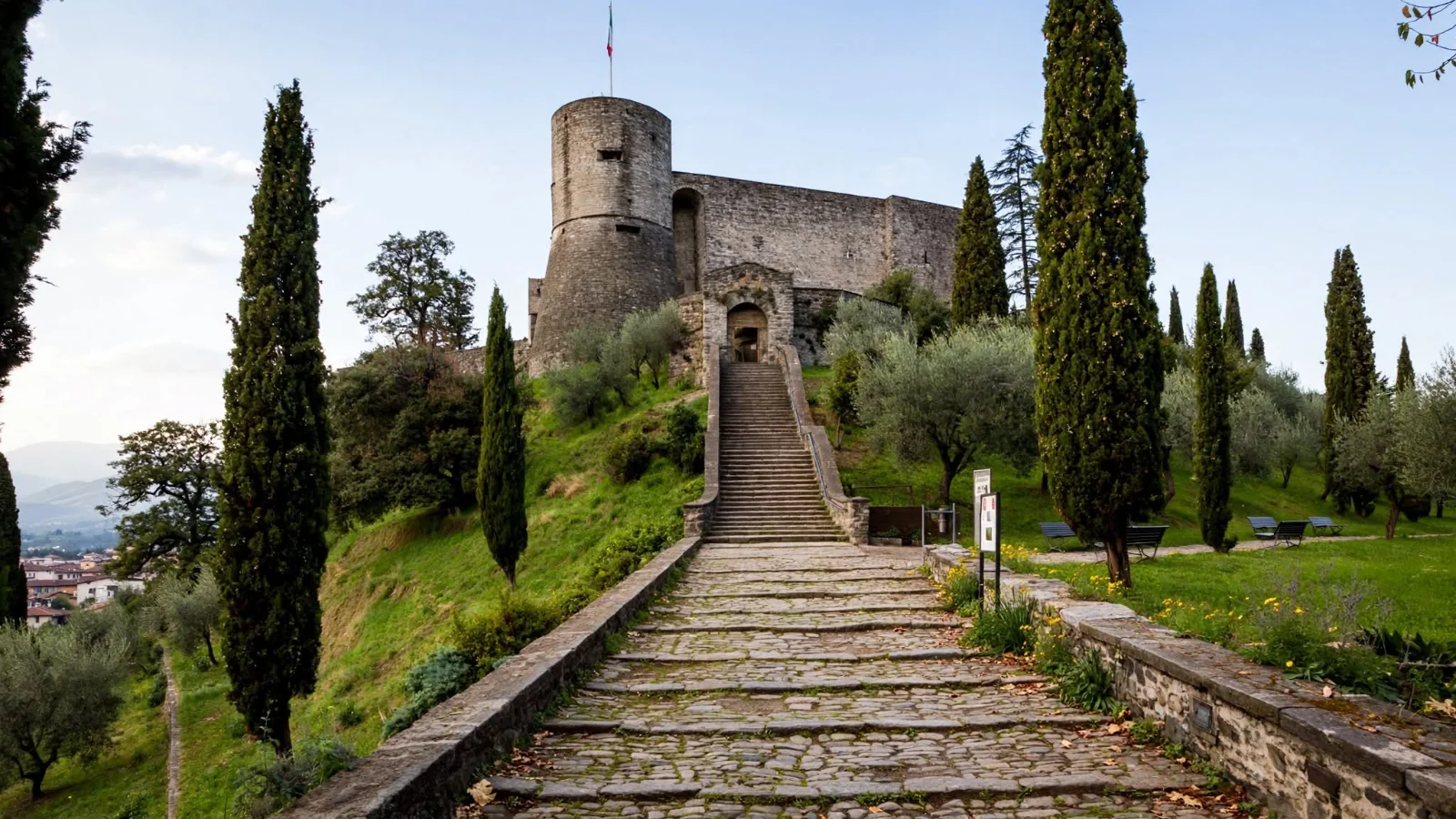
The Claim: Some multi-stop city tours tagged accessible include the Rocca viewpoint on their itinerary, while Viator's attraction page for Rocca di Bergamo warns that many areas are not wheelchair accessible due to the historical nature of the fortress.
The Reality: Museo delle Storie's official access page states plainly that the Rocca building "is not equipped with solutions to overcome architectural barriers." Reaching the fortress from Piazza Mercato del Fieno via Via Solata and Via alla Rocca requires climbing a steep cobblestoned hill, and both the outer gate at Piazzale Brigata Legnano and the museum entrance inside the Remembrance Park are preceded by flights of stairs. The Museo dell'Ottocento inside the Rocca has also been closed since 8 September 2026 for extraordinary maintenance, according to Museo delle Storie, so check the reopening date before you go.
Upcoming improvement to watch: In early September 2026, Bergamo's city council approved in technical terms a feasibility project for two outdoor stairlifts at the Rocca, one at the Piazzale Brigata Legnano entrance stairs and one between the Remembrance Park and the museum courtyard, with an initial budget of €134,700, as reported by BergamoNews and Il Giorno. BergamoNews adds that the project must still be developed to executive design before the works are awarded, and that the Soprintendenza authorized it on 22 June 2026. We found no report of construction starting, so confirm with Museo delle Storie (+39 035 247116) before assuming the stairlifts are in place.
Our verdict:
🔴 Not accessible at present due to the steep uphill approach and entrance staircases. Skip the Rocca climb and use the Viale delle Mura promenade or the Campanone first terrace for panoramic views instead.
Getting Around Bergamo: Airport, ZTL Permits, Toilets and Where to Stay
Most international visitors fly into Milan Bergamo Airport (Orio al Serio, BGY), just 5 km from the city center, or arrive by regional train at Bergamo FS station in Città Bassa. Here is what official records verify for step-free logistics:
- Airport (BGY) and Train Station to Città Alta: According to Visit Bergamo's getting-there page, ATB's Line 1 (Airport Bus) runs every 20 minutes from about 4:50 a.m. to about 1:30 a.m. (from 6:30 a.m. on holidays), starting at stop 1 in the airport's arrivals area. It stops at Bergamo Train Station (Stazione FS), Porta Nuova in Città Bassa, the Lower Funicular Station (Viale Vittorio Emanuele II), and Colle Aperto in Città Alta. ATB's accessibility page says all of its buses have a low floor (maximum 30 cm from the ground) and a boarding platform for wheelchairs, but it also warns that road conditions sometimes prevent optimal access at individual stops, so check the accessible-stop symbols in ATB's route planner.
- Group transfer: Visit Bergamo also lists "Bergamo Easy Access," a bookable ATB city-bus transfer to the Upper Town with pickup near Porta Nuova (Via Camozzi 11) or at Piazzale Goisis (the stadium). It is described as fully accessible, and its capacity of 60 to 80 seats drops to 55 to 75 when a wheelchair passenger is on board.
- Train station assistance: RFI's page for Bergamo station lists an assistance service for passengers with disabilities and reduced mobility, run through the Milan Sala Blu. You can request it in person at a Sala Blu or by phone up to 12 hours before the train's departure or arrival, within the Sala Blu opening hours. RFI lists a step-free route (level or ramp) to platforms 1 and 1 Ovest, and gives the station lift hours as 06:00 to 21:00, so confirm with Sala Blu which platform your train uses when you book.
- Airport assistance: Milan Bergamo Airport strongly recommends booking PRM (passengers with reduced mobility) assistance in advance. Staff accompany departing passengers through the terminal and arriving passengers from disembarkation, and wheelchair users board and leave the aircraft by ambulift on a dedicated route. The airport also lists reserved parking areas P1H and P2H (where assistance is guaranteed), a Sala Amica lounge on the first floor after security with lifts, and a dedicated security access at turnstile no. 3.
- Driving and ZTL Disabled Permit Registration: The Comune di Bergamo runs two limited traffic zones (ZTL) in Città Alta. The historic center zone applies every day from 00:00 to 24:00. The wider Città Alta e Colli zone applies on Sundays and public holidays from 10:00 to 24:00 and on Thursday, Friday and Saturday evenings from 21:00 to 01:00 (from the Thursday after daylight saving time starts to the Saturday before it ends). According to the Comune's ZTL rules, vehicles serving disabled people with the prescribed badge need no ZTL permit but must report their passage, with the disabled person on board. Under the Comune's plate communication procedure, you send the official form to ATB (email
accessi.ztl@atb.bergamo.it) or hand it in at ATB's office at Via Gleno 13 by appointment, with the disabled person's ID, the disability permit and the vehicle registration. The first transit date you state must be no more than 120 hours after you enter the ZTL, and the registration lasts as long as the disability parking permit. ATB's information line is +39 035 364211. In Piazza Mercato del Fieno (300 m from Santa Maria Maggiore), Visit Bergamo lists 1 reserved disabled parking space on cobblestones. - Verified Accessible Restrooms in Città Alta: Santa Maria Maggiore has no toilets. However, Visit Bergamo's technical audits confirm two fully measured accessible restrooms nearby: one on the ground floor of Palazzo Nuovo in Piazza Vecchia (90 cm outward-opening door, 220 x 190 cm room, 48 cm toilet height with grab bars), and another on the ground floor of Palazzo Moroni on Via Porta Dipinta 12 (80 cm folding door, 50 cm toilet height, left grab bar, step-free access). Porta Sant'Agostino also has a basement accessible toilet reached by stairlift.
- Where to Stay (Città Bassa vs Città Alta): Staying in Città Bassa (around Viale Papa Giovanni XXIII and Largo Porta Nuova) gives you wide, flat sidewalks, step-free modern hotels such as the Best Western Hotel Cappello d'Oro, and easy access to the train station and Line 1 bus. If you prefer staying in Città Alta, Le Funi Hotel sits near the San Vigilio funicular and Viale delle Mura and lists 1 accessible room on Visit Bergamo.
So, Is Bergamo Wheelchair Accessible? Our Verdict
Partly, and it works best with route planning. Unlike hill towns where disabled access stops at the valley floor, Bergamo gives wheelchair users two workable ways up to Città Alta (the Line 1 bus to Colle Aperto and the Città Alta funicular) and a flat central piazza complex with elevator access inside historic buildings.
For a smooth one-day itinerary, take the Line 1 bus or the Città Alta funicular to Piazza Mercato delle Scarpe, roll up Via Gombito to Piazza Vecchia, take the 75 cm glass lift up the Campanone to the first terrace, and use the accessible facilities at Palazzo Nuovo. From there, pass under the arches into Piazza Duomo to visit Bergamo Cathedral via its south ramp (with a companion) and Santa Maria Maggiore via its south-west door on Piazza Rosate, then finish with a sunset roll along the Viale delle Mura promenade.
Planning more of Italy? Compare how accessible Siena's hilltop center and Alberobello's trulli district are for wheelchair travelers.
Before You Go: Bergamo Wheelchair Checklist
- Measure your wheelchair's width: the Campanone glass lift door is 75 cm wide, Palazzo del Podestà's lift is 80 cm, and Palazzo Nuovo's lift is 90 cm.
- Check your total loaded weight if using a power chair: both funiculars enforce a 150 kg (330 lb) limit and carry only one wheelchair at a time in the designated accessible cabin.
- Use the priority lane at the lower Città Alta funicular station so staff can assist you onto the accessible car and operate the upper-station stairlift.
- To enter Santa Maria Maggiore without steps, head around to the south-west portal (Piazza Rosate) rather than the main Piazza Duomo steps, and bring a companion for the 7 to 8% cobbled incline.
- For Bergamo Cathedral, use the south side entrance and bring a companion: its steel ramp is 310 cm long and climbs at 18%.
- If driving with a disabled badge, send the plate form to ATB (+39 035 364211 or
accessi.ztl@atb.bergamo.it), keep the first transit date within 120 hours of entering the ZTL, and make sure the disabled person is on board. - Book train station assistance (Sala Blu) at least 12 hours ahead and airport PRM assistance in advance.
Bergamo Wheelchair Accessibility FAQ
Is Bergamo Città Alta wheelchair accessible?
Partly. You can reach the upper town step-free via the funicular railway or the ATB Line 1 bus, and the main spine through Piazza Vecchia and Piazza Duomo is paved in relatively smooth stone slabs. However, secondary lanes have steep cobblestones, and sights like the Colleoni Chapel and Rocca museum have stairs.
Can wheelchair users ride the Bergamo funicular?
Yes, with operator assistance. Only one of the two cabins on the Città Alta funicular is wheelchair accessible, carrying a maximum of one wheelchair per trip with a 150 kg loaded weight limit for motorized chairs. A staff-operated stairlift overcomes the steps at the upper station.
How do I get into the Basilica of Santa Maria Maggiore in a wheelchair?
Use the south-west secondary entrance (Ingresso Sud-Ovest) facing Piazza Rosate, which Visit Bergamo describes as always open, wide and level. The pedestrian approach along Via Mario Lupo has a 7 to 8% downhill slope on cobblestones, so Visit Bergamo recommends having a companion assist.
Can a wheelchair go up the Campanone bell tower in Piazza Vecchia?
Yes, up to the first panoramic terrace. A glass elevator serves the first terrace, so you avoid climbing the 230 steps, though Museo delle Storie specifies that the lift doorway is 75 cm wide, which may be too narrow for larger power wheelchairs.
Are there accessible public restrooms in Bergamo Città Alta?
Yes. Visit Bergamo's accessibility audits confirm a step-free ground-floor accessible restroom inside Palazzo Nuovo on Piazza Vecchia (90 cm door, grab bars) and another inside Palazzo Moroni on Via Porta Dipinta (80 cm door). Santa Maria Maggiore has no toilets, and Porta Sant'Agostino has a basement accessible toilet reached by stairlift.
How do I get from Milan Bergamo Airport (BGY) to Città Alta in a wheelchair?
Take ATB Bus Line 1 from stop 1 outside the airport arrivals terminal. ATB says all its buses have a low floor and a boarding platform for wheelchairs. The line stops at the central train station, the lower funicular station in Città Bassa, and Colle Aperto at the top of Città Alta.
Can you drive into Bergamo Città Alta with a disabled badge?
Yes. Vehicles carrying a disabled person with the official badge need no ZTL permit in Bergamo but must report their plate to ATB (accessi.ztl@atb.bergamo.it, +39 035 364211), with a first transit date no more than 120 hours after entering. Piazza Mercato del Fieno has one reserved parking space on cobblestones.
Is the Colleoni Chapel wheelchair accessible?
No. Visit Bergamo's official page for the Cappella Colleoni lists motor accessibility as no, and a flight of steps behind the wrought-iron gate blocks wheelchair entry. Some tours tagged wheelchair accessible still include it as a stop, so you can only admire its inlaid marble facade from the square.
Discussion
No comments yet. Be the first to share your thoughts.
Leave a comment