
Author: Jaziba Luqman
Last updated: October 2026
Jaziba Luqman writes TheDailyFront's wheelchair-accessibility travel series, cross-checking tourism claims against official accessibility databases, operator listings, and traveler accounts.
Is Munich wheelchair accessible? Largely yes. All 100 Munich U-Bahn stations have elevator access, the Deutsches Museum is certified with 90 cm lift doors and 6% ramps, and BMW Welt provides seven elevators across every level. However, Nymphenburg Palace's main lift is 87 cm wide (with three park pavilions blocked by steps), and the Olympic Tower viewing platform is closed for renovation until 2027.
Quick answer: Munich is one of the easiest major European cities to navigate in a wheelchair, rivaling Berlin and Frankfurt for step-free transit and museum access. BMW Welt, the Deutsches Museum, and the ground-level stalls of Viktualienmarkt are straightforward to visit, while the Neues Rathaus viewing tower and Nymphenburg Palace's upper staterooms work well if your wheelchair fits their 80 to 87 cm elevator clearances. Drop the Olympic Tower from your itinerary until 2027, and skip Nymphenburg's outer garden pavilions unless you have a companion and staff assistance.
In this guide: Marienplatz & Neues Rathaus · BMW Welt & Museum · Olympiapark & Olympic Tower · Nymphenburg Palace · Deutsches Museum · Viktualienmarkt · Getting Around, Airport & Toilets · Verdict · Before You Go · FAQ
At a Glance: Is Munich Wheelchair Accessible? Verdicts by Sight
How to read our verdicts:
🟢 Accessible according to the cited evidence.
🟡 Accessible with limitations or assistance.
🟠 Significant limitations: reachable only in part, or only with substantial help.
🔴 Not wheelchair accessible for the described area.
| Attraction | Marketed As | Wheelchair Accessible? Our Verdict |
|---|---|---|
| Marienplatz & Neues Rathaus | Munich Tourism: barrier-free square & tower lift | 🟡 Flat square with cobblestone strips; tower viewing platform reachable via courtyard lift (4th-floor transfer) |
| BMW Welt & BMW Museum | München Barrierefrei: fully accessible | 🟢 7 lifts in BMW Welt, 12 disabled parking bays, and museum lifts plus a 12% spiral ramp |
| Olympiapark & Olympic Tower | Tour guides: wheelchair accessible highlight | 🟡 Lakeside paths paved (75 cm park train entry), but steeper hills challenge manual chairs and Olympic Tower is closed until 2027 |
| Nymphenburg Palace & Park | Bavarian Palaces: accessible in parts | 🟡 Palace (87 x 135 cm lift) and Porcelain Museum (130 x 200 cm lift) accessible; 3 of 4 park pavilions blocked by steps |
| Deutsches Museum | Reisen für Alle: certified barrier-free | 🟢 90 cm lift doors, 140 cm wide ramps (max 6% slope) and 4 accessible restrooms; huge floor area requires pacing |
| Viktualienmarkt | Tour listings: all surfaces wheelchair accessible | 🟡 Level asphalt aisles and accessible South Side / Frauenstraße toilets, but tight midday crowds and basement steps at the beer garden WC |
Munich actively promotes its "München Barrierefrei" (Barrier-Free Munich) portal, and the city's official tourism board documents step-free sights, museums, guided tours, and public transport across the Bavarian capital. Yet third-party travel guides and booking platforms still list the Olympic Tower's viewing platform as a must-do accessible viewpoint without mentioning that it has been closed since June 2024 and will not reopen until 2027.
Our methodology:
The claim: How official tourism overviews, third-party city guides, and commercial tour operators label Munich's six best-known attractions.
The reality: We cross-checked every claim against the city's official München Barrierefrei database, municipal venue measurements on Kultur Barrierefrei München, Munich Tourism's Munich for Everybody portal, the Bavarian Palace Administration's Nymphenburg mobility sheet, and the Deutsches Museum's Reisen für Alle audit.
Verified door widths, lift cabins, and ramp gradients: Under Germany's DIN 18040-1 accessibility standard, standard wheelchair-accessible doors start at 90 cm and interior ramps should not exceed 6%. Here are the exact figures recorded across Munich's official venue audits:
Slope bars are scaled to 20%; door and cabin width bars are scaled to 100 cm (with the 127 cm Rathaus elevator door capped at 100%).
1. Are Marienplatz and the Neues Rathaus Wheelchair Accessible?
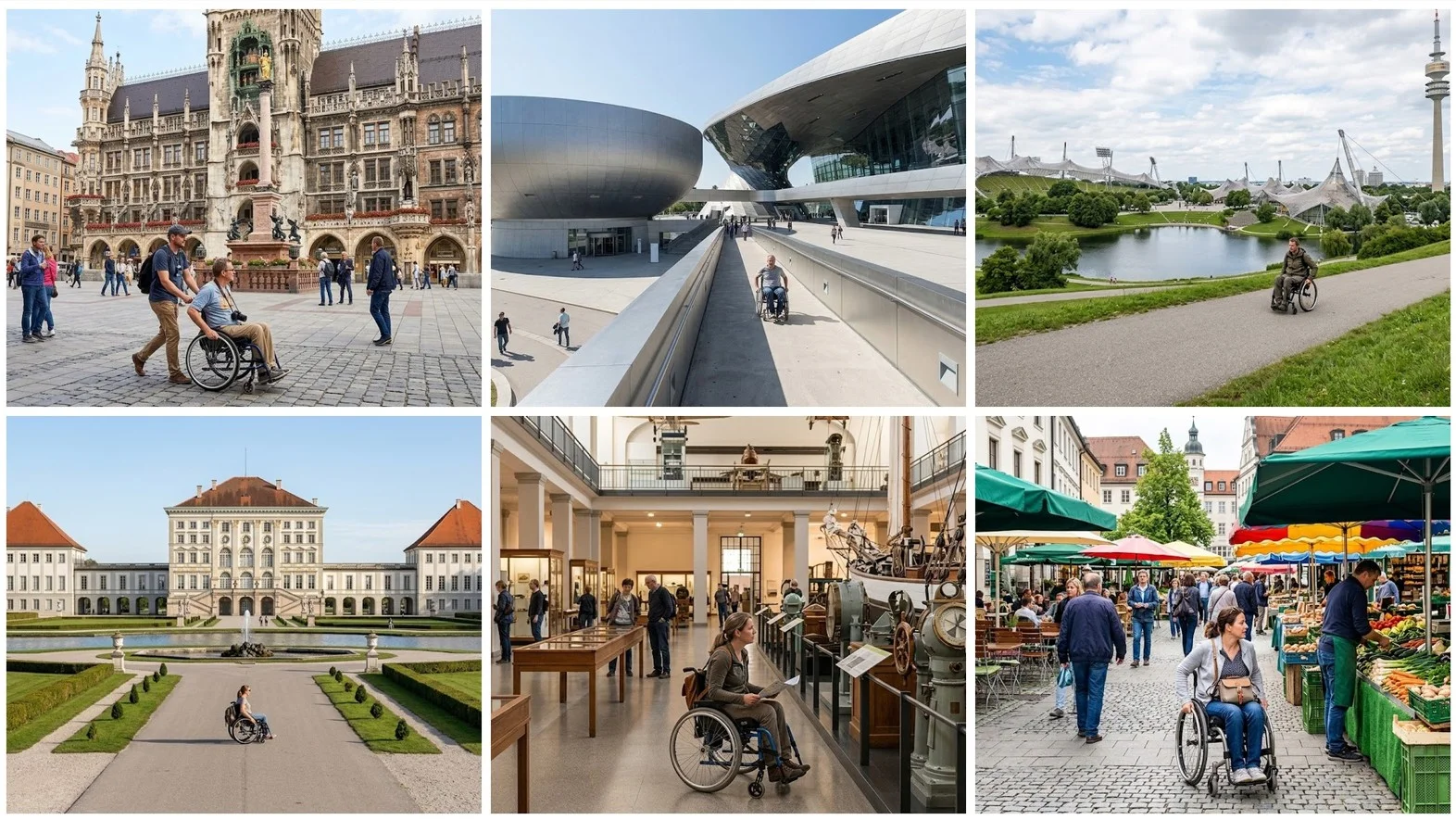
Short answer: Mostly yes. The pedestrian square is flat and the 85-meter Neues Rathaus viewing tower is reachable via two elevators (transferring on the 4th floor), though surrounding shops often have entrance steps.
The Claim: Munich Tourism's Munich for Everybody guide presents Marienplatz and the Neues Rathaus (New Town Hall) as core stops on the city's barrier-free Old Town route, noting that the 9th-floor viewing platform on the Rathaus tower is accessible by lift.
The Reality: The step-free route to the top of the town hall tower works as advertised, provided you follow the specific two-lift boarding procedure and prepare for dense crowds around the Glockenspiel at 11:00 a.m. and 12:00 p.m.
Access details:
- Rathausturm viewing platform (85 m): According to Munich Tourism's official Rathausturm booking page, you reach the first elevator inside the passage leading to the Prunkhof (state courtyard) at Marienplatz 8, which takes you to the 4th floor. From the 4th-floor waiting point, staff admit up to 30 visitors per 20-minute time slot into the tower lift up to the 9th-floor viewing gallery. Backpacks and large bags must be left with the ground-floor porter (Pförtner), and companions of visitors with a "B" mark on their disability pass receive a free ticket at the Tourist Information office or via
tourismus.gs@muenchen.de. - Neues Rathaus entrance and elevator dimensions: Municipal audit data on Kultur Barrierefrei München records a threshold-free stone entrance next to the porter's lodge (double wooden doors measuring 2 x 95 cm wide). The lift at the accessible entrance has an 80 cm door width and a 95 x 140 cm cabin, while a larger internal building elevator (accessible from outside by asking at the porter's lodge) has a 127 cm door width and a 105 x 220 cm cabin with raised buttons and voice announcements. Wheelchair-accessible toilets and a first-aid room are available inside.
- Square paving and "Toilette für alle": While Marienplatz is flat and served by U-Bahn and S-Bahn elevators, sections of historic small-stone paving and single steps at older ground-floor shops and cafés require attention. Below the square on the concourse level (Sperrengeschoss near Exit D toward Viktualienmarkt), Toiletten für Alle confirms a fully equipped Changing Places facility (open 06:00 to 24:00 via Euro-key) fitted with a ceiling hoist and height-adjustable changing bench.
Our verdict:
🟡 Partially accessible: Marienplatz and the Neues Rathaus viewing tower are step-free via courtyard elevators, though the 80 cm secondary lift door, uneven cobblestone strips, stepped shopfronts, and peak Glockenspiel crowds require planning.
2. Are BMW Welt and the BMW Museum Wheelchair Accessible?
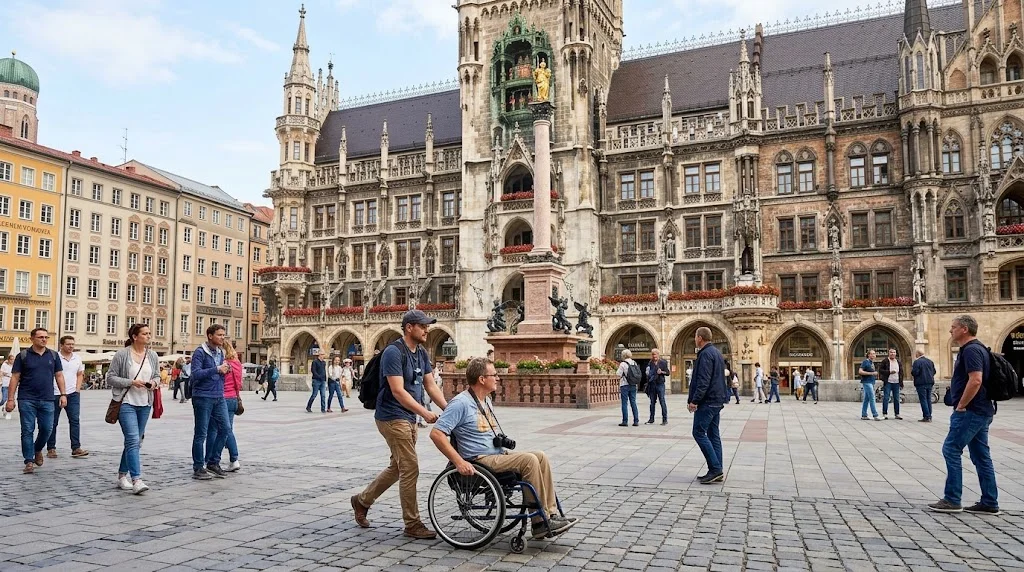
Short answer: Yes. BMW Welt has step-free entrances, 7 elevators, and 12 underground disabled parking bays, while the adjacent BMW Museum combines lifts to all levels with a 12% spiral ramp.
The Claim: Both BMW Welt and the BMW Museum are marketed as showcase modern attractions with step-free entrances, elevators, ramps, and accessible restrooms.
The Reality: Official audits on München Barrierefrei for BMW Welt, München Barrierefrei for the BMW Museum, and Kultur Barrierefrei München confirm that the complex is one of the easiest attractions in Germany to visit in a wheelchair.
Access details:
- BMW Welt (Am Olympiapark 1): Opened in 2007 with full barrier-free design, BMW Welt is free to enter and features threshold-free automatic entrances from the Olympiazentrum U3 station forecourt. Seven large passenger elevators connect every floor, including the elevated pedestrian bridge over Georg-Brauchle-Ring to the BMW Museum. Loaner wheelchairs can be requested at the ground-floor information counter.
- BMW Museum (Am Olympiapark 2): Reached via an entrance ramp and electric door opener, the circular 1973 museum building uses elevators to connect every exhibition level up to the central "Spindel" walkway, which spirals on a continuous ramp with a 12% incline. Manual wheelchair users who find the 12% ramp steep on the way up can take the lift to the top and roll down. Visitors with a disability pass receive reduced admission, and a documented companion ("B" mark) enters free.
- 12 Disabled Parking Spaces & E-Charging: The underground garage beneath BMW Welt provides 12 designated disabled parking spaces with direct elevator access: 6 spaces on Parking Deck 1 (Blocks C and D, including 2 spaces in Block D with e-charging) and 6 spaces on Parking Deck 2 (Blocks F, G, and H, including 4 spaces with e-charging where the power socket is set at 100 cm height and the payment sensor at 120 cm height). Accessible restrooms are located on multiple levels across both buildings.
Our verdict:
🟢 Fully accessible: With 7 elevators in BMW Welt, 12 accessible underground parking bays, free loaner chairs, and full lift coverage in the BMW Museum, the complex is effortless to navigate.
3. Are Olympiapark and the Olympic Tower Wheelchair Accessible?
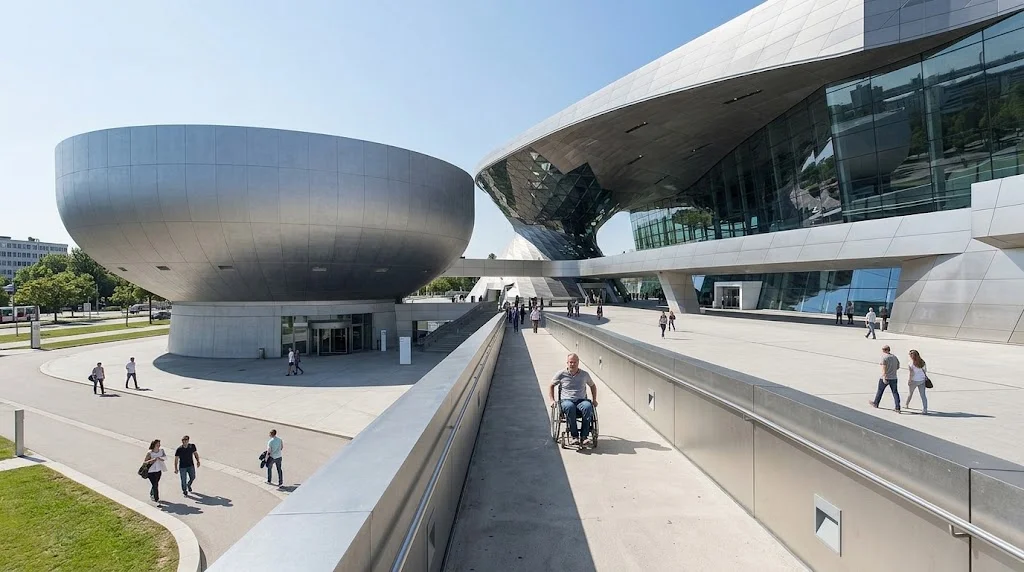
Short answer: Partly for the park, and no for the tower. Main lakeside paths are paved and the park train takes manual chairs up to 75 cm wide, but surrounding hills are steep and the Olympic Tower is closed until 2027.
The Claim: Olympiapark is promoted as a barrier-free leisure complex directly across from BMW Welt, and numerous travel blogs still list the 291-meter Olympic Tower (Olympiaturm) as a top wheelchair-accessible viewpoint.
The Reality: While the primary lakeside promenades are smooth, two major operational facts—hill gradients and a multi-year tower closure—directly affect wheelchair visitors.
Access details:
- Olympic Tower (Olympiaturm) closed until 2027: According to Munich Tourism's official Olympiapark page, the Olympic Tower has been completely closed to visitors since 1 June 2024 for comprehensive structural and technical renovation and is not scheduled to reopen until 2027. Do not purchase third-party city passes expecting tower access.
- Park terrain and Parkeisenbahn (Mini-Train): The München Barrierefrei audit for Olympiapark describes the 85-hectare grounds as "partly flat, partly hilly terrain with paved asphalt paths" (teils ebenes, teils hügeliges Gelände mit asphaltierten Wegen). Rolling around the Olympiasee and stadium forecourt is straightforward, whereas climbing the Olympiaberg hill involves steep gradients. To save energy across the sprawling park, the sightseeing Parkeisenbahn (park train) offers a wheelchair space in its middle carriage with a 75 cm entry width where the driver deploys a portable ramp and assists boarding; however, München Barrierefrei explicitly notes that heavy electric wheelchairs cannot be carried (keine schweren Elektrorollstühle).
Our verdict:
🟡 Partially accessible: The main asphalt paths around the Olympic Stadium and lake are rollable and the park train accommodates manual chairs under 75 cm wide, but steep hills limit off-path exploring and the Olympic Tower is closed until 2027.
4. Is Nymphenburg Palace Wheelchair Accessible?
Short answer: Partly. The main palace (87 x 135 cm lift, 85 cm+ doors) and Porcelain Museum (130 x 200 cm lift, 92 cm+ doors) are step-free, but three of the four park pavilions are blocked by steps.
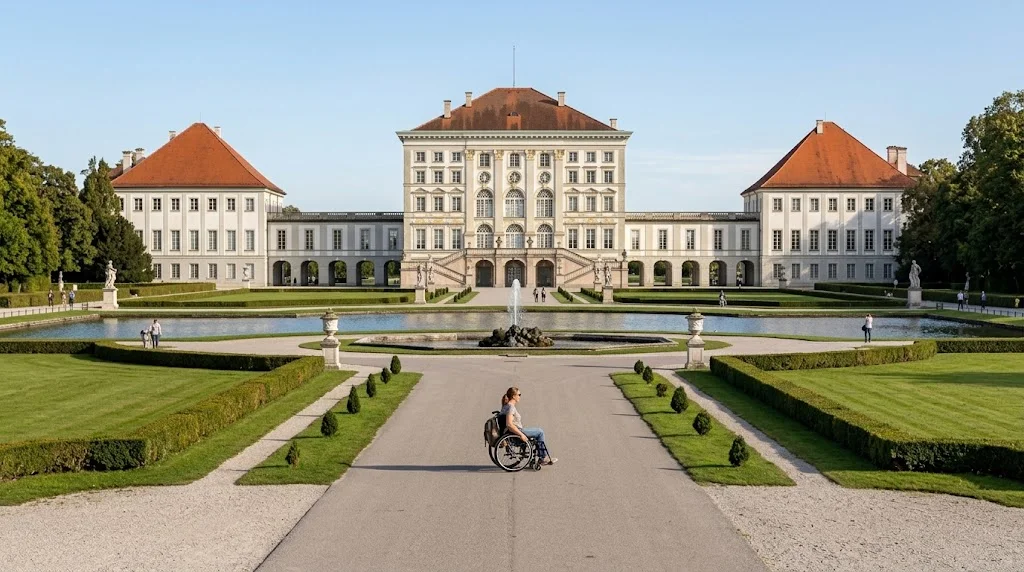
The Claim: Tour listings generally mark Nymphenburg Palace as wheelchair accessible or partly accessible without distinguishing between the main Baroque palace, the carriage museum, and the park pavilions.
The Reality: The Bavarian Palace Administration's official Nymphenburg mobility guide publishes exact cabin and doorway measurements that show exactly which buildings work for manual and power wheelchairs.
Access details:
- Main Palace (Schloss Nymphenburg): A separate step-free entrance sits immediately to the left of the main entrance (and from the garden side in summer). Upper-floor state rooms—including the famous Gallery of Beauties and Stone Hall—are reached step-free via an elevator measuring 87 cm wide by 135 cm long, and all interior exhibition doorways are at least 85 cm wide over level, non-slip flooring.
- Marstallmuseum & Nymphenburg Porcelain Museum: The ground-floor carriage museum has a step-free entrance, and the upstairs Porcelain Museum is served by a larger elevator measuring 130 cm wide by 200 cm long, with interior doorways at least 92 cm wide.
- Palace Park and the 4 Park Palaces (Pavilions): Main park paths are mostly asphalt or compacted paved gravel with few slopes. However, the four historic park pavilions have major limitations:
- Amalienburg: Step-free entry is possible via mobile ramps, but you must ask staff on-site to deploy them.
- Pagodenburg: Although a mobile ramp is available, the palace administration warns that "access is nevertheless not barrier-free, as a high step remains despite the ramp," and the upper floor is reached only by a narrow staircase.
- Badenburg and Magdalenenklause: Both buildings are reachable only via several steps with no ramp or lift.
- Disabled Parking and Restrooms: Five designated disabled parking spaces are located in the main car park in front of the palace, approximately 200 meters from the ticket office along a level path of paved gravel and cobblestones. Accessible toilets are located on the ground floor inside the main palace and at the rear of the palace (accessible from outside).
Our verdict:
🟡 Partially accessible: The main palace (87 x 135 cm lift), Marstallmuseum, Porcelain Museum (130 x 200 cm lift), and primary park avenues are well adapted, while Pagodenburg, Badenburg, and Magdalenenklause remain inaccessible to solo wheelchair users.
5. Is the Deutsches Museum Wheelchair Accessible?
Short answer: Yes. Independently certified by Reisen für Alle, the museum provides 90 cm elevator and passage doors, 140 cm wide ramps (max 6% slope), and four documented accessible restrooms.
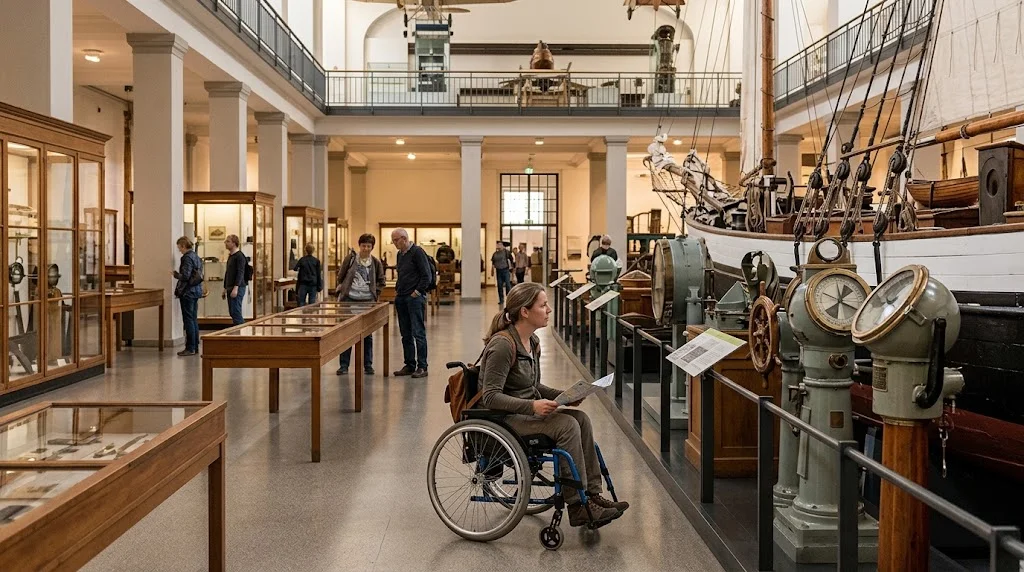
The Claim: The Deutsches Museum promotes its renovated Museumsinsel headquarters as fully barrier-free, with step-free access to all exhibition levels.
The Reality: The museum holds Germany's official "Reisen für Alle" certification, and its published accessibility audit and München Barrierefrei profile confirm exact architectural dimensions across the building.
Access details:
- Entrances, Ramps, and Elevators: Entry into the main building is completely step-free. Every public exhibition room is reachable without steps via interior ramps (at least 140 cm wide with a maximum longitudinal slope of 6%), passenger elevators (minimum 90 cm door width and 100 x 150 cm cabin), or platform lifts (90 cm wide by 300 cm deep). All exhibition doorways and passages are at least 90 cm wide.
- Lowered Counters and Seated Viewing: The ticket counter is lowered to 80 cm at its lowest section, the main information desk to 82 cm, and the Kids' Kingdom (Kinderreich) counter to 75 cm. Exhibits are positioned to be visible from a seated position, and loaner wheelchairs and portable folding stools are available at the entrance.
- 4 Measured Accessible Restrooms: The Reisen für Alle audit documents four wheelchair-accessible restrooms with fold-up grab bars on both sides, emergency pull cords, and sinks with 67 cm vertical knee clearance:
- Entrance Building WC: 214 x 200 cm turning space; 106 x 70 cm left and 113 x 70 cm right transfer space.
- Auditorium WC: 150 x 190 cm turning space; 114 x 70 cm left and 100 x 70 cm right transfer space.
- Level 2 WC: 150 x 150 cm turning space in front of the toilet; 99 x 70 cm left and 100 x 70 cm right transfer space.
- Kinderreich WC: 165 x 165 cm turning space; 93 x 70 cm left and 92 x 70 cm right transfer space.
- Pacing the Scale: Because the museum spans 20 themed exhibitions across thousands of square meters, covering it in a single push is exhausting for manual wheelchair users; pick 3 or 4 galleries per visit.
Our verdict:
🟢 Accessible: With 90 cm lift doors, gentle 6% ramps, four spacious accessible restrooms, and lowered counters, the physical infrastructure is exemplary; just pace your route across the massive complex.
6. Is the Viktualienmarkt Wheelchair Accessible?
Short answer: Mostly yes. The outdoor market lanes and beer garden seating are step-free on asphalt and flat paving stones, though the central beer garden toilet is down basement stairs—use the step-free South Side or Frauenstraße accessible restrooms instead.
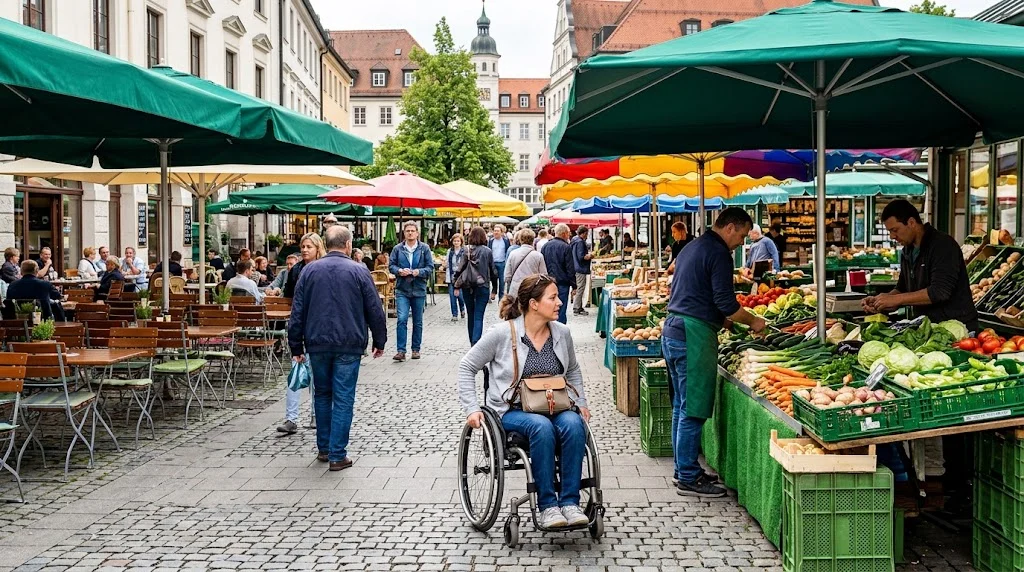
The Claim: Guided food tours and city itineraries covering the Viktualienmarkt routinely apply a blanket "all areas and surfaces are wheelchair accessible" label, and Munich Tourism highlights the market's shaded beer garden as an accessible stop.
The Reality: Rolling between the 140 stalls and pulling up to the movable wooden tables in the central beer garden is step-free, but wheelchair visitors need to know where the accessible restrooms actually are and how midday crowds affect navigation.
Access details:
- Ground surface and midday crowding: Located a two-minute roll south of Marienplatz, the 22,000-square-meter market square is mostly flat asphalt and level paving slabs with dropped curbs at street crossings. However, between 11:30 a.m. and 2:00 p.m., narrow aisles between food stalls and the self-service beer garden tables fill tightly with standing crowds, making it much easier to visit before 11:00 a.m.
- Restroom trap vs. verified accessible toilets: According to Viktualienmarkt's visitor facility guide, the public toilet directly inside the central beer garden (west of the snack stand) is reached only via a staircase down into the basement. Wheelchair users should instead use the barrier-free public toilet facility on the South Side of the market, the barrier-free public toilet at the corner of Frauenstraße and Westenriederstraße (open Monday to Saturday, 06:30 to 19:30), or the Euro-key Changing Places facility ("Toilette für alle") at the Marienplatz concourse entrance (Exit D / Viktualienmarkt). Adjacent major stores such as Kustermann (Viktualienmarkt 8) are also listed on München Barrierefrei with elevator access.
Our verdict:
🟡 Partially accessible: The outdoor market aisles and beer garden seating are flat and step-free, provided you arrive before peak lunch crowds and use the step-free South Side or Frauenstraße restrooms rather than the basement beer garden stairs.
Getting Around Munich: Airport, 100% Step-Free U-Bahn, and Public Assistance
Munich's public transit network is one of the most systematically adapted in Europe. Here is what official transport authorities verify for wheelchair travelers:
- 100% Step-Free U-Bahn & S-Bahn Network: According to the Munich Transport and Tariff Association (MVV), all 100 U-Bahn (subway) stations in Munich are step-free via elevators from street level to the platform, and modern U-Bahn trains offer level boarding at high platforms. Approximately 85% of the region's 150 S-Bahn stations are also step-free (including the core city-center tunnel stations at Hauptbahnhof, Karlsplatz/Stachus, Marienplatz, Isartor, and Ostbahnhof). You can check live elevator status by calling the U-Bahn control center at +49 89 2191-3333 or the S-Bahn 3S center at +49 89 1308-1055.
- City Buses, Trams, and Free Companion Service: MVG city buses and low-floor trams are equipped with fold-out boarding ramps and dedicated wheelchair bays. The City of Munich also provides a free public transit companion service (Mobilitätsservice) Monday to Friday from 08:00 to 18:00 within the city area; book at least two working days in advance at +49 89 5449-18920.
- Munich Airport (MUC) Mobility Service: Munich Airport's Mobility Service operates dedicated Mobility Service Points at Terminal 1 (Module B, Level 04) and Terminal 2 (Departure Area, Level 04), an accessible security checkpoint in Terminal 2, a Changing Places toilet, and step-free S-Bahn lines (S1 and S8) directly into central Munich. Register PRM assistance with your airline at least 48 hours before departure.
- Munich Central Station (Hauptbahnhof) & Disabled Parking: Like Frankfurt, München Hauptbahnhof is an above-ground terminus station where main long-distance platforms meet the concourse without stairs. For drivers with an official blue EU disabled parking badge, street-by-street locations of reserved bays are mapped on the city's official GEO Portal for Accessibility (Behindertenparkplätze) linked on every München Barrierefrei venue page.
So, Is Munich Wheelchair Accessible? Our Verdict
Largely yes. Because every U-Bahn station has an elevator and flagship venues like BMW Welt and the Deutsches Museum were built or renovated around strict accessibility standards, getting across Munich in a wheelchair is remarkably smooth.
For an effortless two-day itinerary, pair one outdoor historic area with one modern indoor venue each day: start Day 1 early at Marienplatz (take the courtyard lift to the 4th floor and transfer to the 9th-floor Neues Rathaus tower) and roll south to Viktualienmarkt before the lunchtime rush, then spend the afternoon inside the Deutsches Museum (90 cm lifts, 6% ramps). On Day 2, take the U3 to Olympiazentrum to visit BMW Welt and the BMW Museum, roll around the flat lakeside paths of Olympiapark (skipping the closed Olympic Tower), or head to Nymphenburg Palace to see the state rooms (87 x 135 cm lift) and Porcelain Museum (130 x 200 cm lift).
Planning more accessible European trips? Compare our findings in our London wheelchair accessibility guide and our Ronda accessibility breakdown.
Before You Go: Munich Wheelchair Checklist
- Drop the Olympic Tower (Olympiaturm) from your 2026 plans: it has been closed since 1 June 2024 for renovation and will not reopen until 2027.
- Check your wheelchair dimensions against Munich's historic lifts: Nymphenburg Palace's main lift cabin is 87 cm wide by 135 cm long (doors 85 cm+), the Neues Rathaus accessible entrance lift has an 80 cm door (ask the porter for the 127 cm internal lift if needed), and the Olympiapark mini-train middle car entry is 75 cm wide (no heavy power chairs).
- For the Neues Rathaus 9th-floor viewing tower, use the elevator in the passage to the Prunkhof courtyard up to the 4th floor to join your 20-minute time slot, and claim a free companion ticket ("B" mark) at the Marienplatz Tourist Information office.
- At Viktualienmarkt, avoid the central beer garden restroom (located down basement stairs) and use the step-free accessible toilets on the South Side of the market, at Frauenstraße / Westenriederstraße, or the Euro-key Changing Places facility at Marienplatz Exit D.
- At Nymphenburg Palace, stick to the main palace, Marstallmuseum, Porcelain Museum, and paved park paths; ask staff for the mobile ramp at Amalienburg, and skip Pagodenburg, Badenburg, and Magdalenenklause due to steps.
- Save the live MVV elevator status hotlines in your phone: +49 89 2191-3333 for the U-Bahn and +49 89 1308-1055 for the S-Bahn.
Munich Wheelchair Accessibility FAQ
Is Munich wheelchair accessible for tourists?
Largely yes. All 100 U-Bahn subway stations in Munich have step-free elevator access, city buses and trams carry boarding ramps, and major indoor attractions like the Deutsches Museum (90 cm lift doors) and BMW Welt (7 elevators) are fully barrier-free. Only specific historic pavilions and cobblestones require workarounds.
Is Marienplatz and the Neues Rathaus viewing tower wheelchair accessible?
Yes. Marienplatz is flat and pedestrianized, though bordered by some cobblestone strips and stepped shopfronts. To reach the 9th-floor viewing platform on the 85-meter Neues Rathaus tower, take the elevator inside the Prunkhof courtyard passage to the 4th floor, where staff escort up to 30 visitors into the tower lift.
Can wheelchair users visit BMW Welt and the BMW Museum?
Yes. BMW Welt is completely step-free with 7 elevators serving every floor, free loaner wheelchairs at the info desk, and 12 designated disabled parking spaces in its underground garage. Across the bridge, the BMW Museum combines elevators to all levels with a 12% spiral ramp and free companion entry.
Is the Olympic Tower (Olympiaturm) in Munich open and accessible?
No. Although many travel guides still list the Olympic Tower viewing platform as a wheelchair-accessible highlight, Munich Tourism confirms the tower has been closed since 1 June 2024 for major renovations and will not reopen until 2027. The paved lakeside paths of Olympiapark remain open and accessible.
Is Nymphenburg Palace wheelchair accessible?
Partly. The main palace has a step-free entrance to the left of the main doors and an elevator (87 cm wide by 135 cm long, doorways at least 85 cm wide) to the upstairs state rooms, while the Porcelain Museum has a 130 x 200 cm lift. However, Pagodenburg, Badenburg, and Magdalenenklause have steps.
Is the Deutsches Museum in Munich wheelchair accessible?
Yes. Certified by Reisen für Alle, the Deutsches Museum provides step-free access to all exhibition areas via 140 cm wide ramps (maximum 6% slope), elevators with 90 cm doors and 100 x 150 cm cabins, lowered counters (80 to 82 cm), free loaner wheelchairs, and four documented accessible restrooms.
Are there wheelchair-accessible toilets at Viktualienmarkt?
Yes, on the perimeter of the market. While the restroom inside the central beer garden is down a flight of basement stairs, step-free wheelchair-accessible public toilets are located on the South Side of Viktualienmarkt, at the corner of Frauenstraße and Westenriederstraße, and inside the nearby Marienplatz concourse (Exit D).
Discussion (1)
C’est très intéressant Merci beaucoup
Leave a comment