
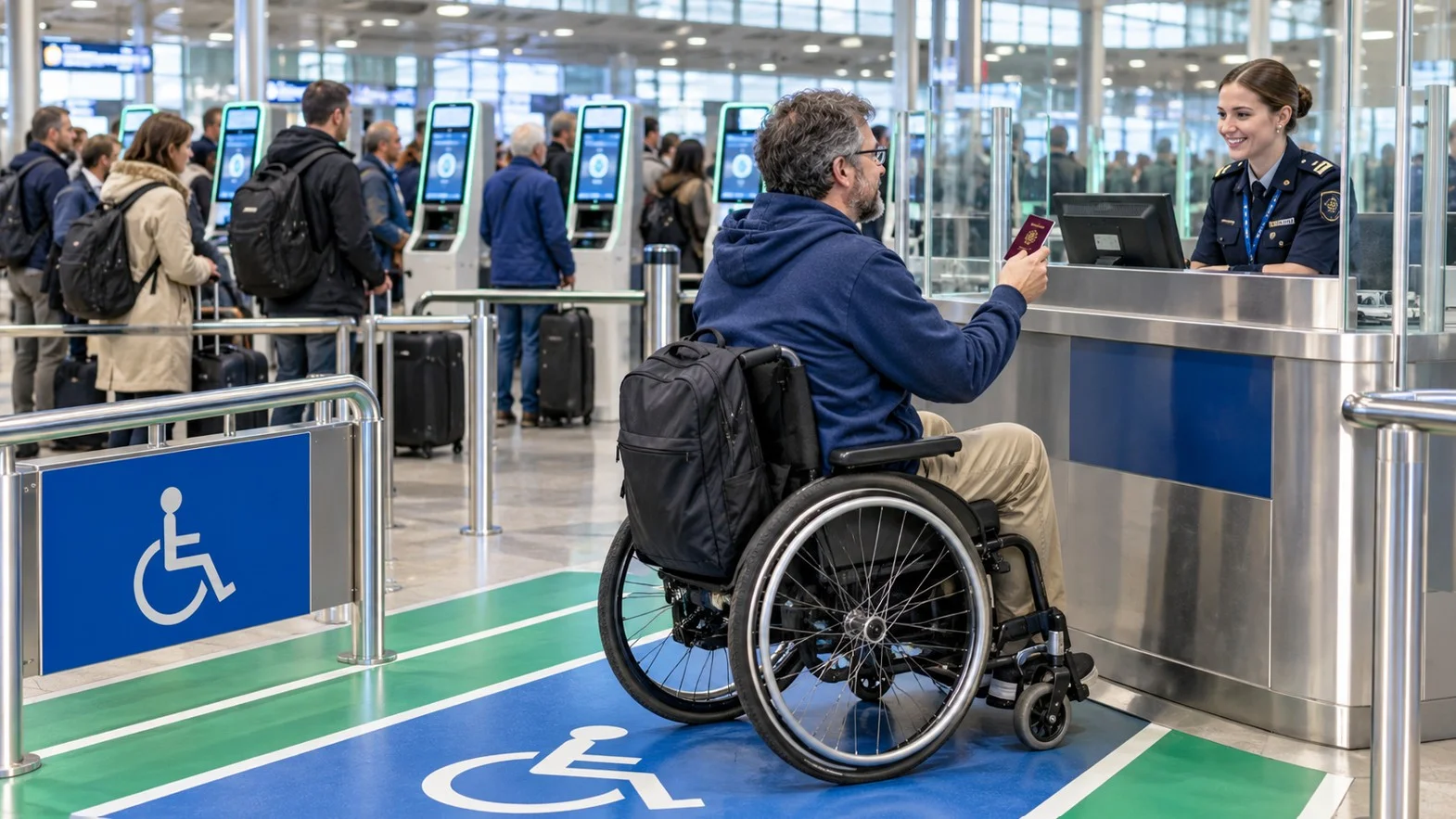
You have been awake for 14 hours, your wheelchair is finally back at the aircraft door, and ahead sits a biometric kiosk mounted at standing height behind a queue that has not moved in twenty minutes. The EU Entry/Exit System (EES) is mandatory for non-EU short-stay visitors, and its self-service kiosks were not built around seated travelers. The practical reality is that you do not have to use those kiosks: several major Schengen airports register passengers with reduced mobility at staffed counters or dedicated assistance lanes instead.
No, wheelchair users cannot skip EES biometric registration, but you do not have to use self-service kiosks that are not wheelchair accessible. Major hubs including Brussels, Munich, Amsterdam Schiphol, Madrid, and Barcelona offer manual border desks or dedicated PRM lanes. Request special assistance at least 48 hours before departure, confirm your arrival airport's setup by email, and do not pay any site for ETIAS yet because applications remain closed.
| Border element | What applies to wheelchair users (2026 to 2027) | Key action |
|---|---|---|
| EES registration | Mandatory for non-EU visitors on short stays (up to 90 days in any 180-day period) across 29 Schengen countries | Plan for biometric enrolment on first entry |
| Self-service kiosks | Not mandatory if inaccessible from a wheelchair; border officers can process you manually | Ask for a staffed desk or PRM lane |
| 3-year record validity | Biometric file stays active for 3 years (or until passport expiry) after initial enrolment | Expect faster verification on repeat trips |
| PRM assistance notice | Free under EU Regulation (EC) 1107/2006 at European airports | Book at least 48 hours before departure |
| Fingerprint exemption | Exempt under Regulation (EU) 2017/2226 if physically impossible | Inform the officer at the manual booth |
| ETIAS authorization | Not live yet; no confirmed start date (20 euros once launched) | Do not pay any third-party site |
What Is EES, and How Long Does Registration Last?
The Entry/Exit System (EES) is the European Union's digital border system for non-EU citizens visiting for short stays of up to 90 days within any 180-day period. On your first crossing, border systems record your passport data, four fingerprints, and a live facial photograph, replacing manual passport stamps. According to the official European Union EES portal, the system became fully operational on April 10, 2026 across 29 European countries at Schengen external borders. Cyprus and Ireland remain outside the Schengen area, so EES does not operate there.
One detail many first-time visitors miss is how long your registration lasts. Under EES Regulation (EU) 2017/2226, your individual biometric record stays stored for three years from your last exit (or until your passport expires, whichever comes first). You do not repeat full enrolment on every trip. Once your initial profile is in the system, subsequent crossings require only a quick identity verification, which significantly reduces time at the booth.
First-entry queues have been the main friction point since launch. In July 2026, airport and airline groups including ACI Europe, Airlines for Europe (A4E), and IATA sent an open letter to the European Commission warning of waits reaching up to five hours during peak arrival waves. An October 2026 update from ACI Europe and A4E reported that peak waits still routinely exceed two hours and reach five hours in the most extreme cases. Those figures represent peak congestion rather than every flight, but wheelchair users need reliable buffer time when booking onward trains or accessible transfers.
Do Wheelchair Users Have to Use EES Kiosks?
No. Most airport pre-registration kiosks are fixed at standing height with angled cameras and fingerprint scanners that seated travelers cannot comfortably reach. Ahead of rollout, the EU Agency for Fundamental Rights (FRA) issued accessibility guidance advising border authorities to provide adequate maneuvering space for wheelchairs, adjustable-height kiosks with voice support, and mobile biometric capture units for travelers with reduced mobility.
Where an accessible kiosk is unavailable or unusable, border officers can capture your passport details, fingerprints, and facial image manually at a staffed booth. The Royal Netherlands Marechaussee confirmed this manual fallback procedure to The Independent.
Important reality check: Skipping the self-service kiosk does not guarantee a fast crossing. Manual border booths can also develop long queues during heavy long-haul arrival waves, and no airport promises zero wait times in PRM lanes. The advantage is avoiding standing-only hardware and having staff manage your place in the border flow.
European Airports With Confirmed PRM Options for EES
Border layouts and hardware rollouts continue to evolve across Europe. Use the table below as a starting point, then email your arrival airport's passenger assistance team before flying and save their written reply on your phone.
| Airport | Confirmed PRM arrangement for EES | Key note for 2026 to 2027 |
|---|---|---|
| Brussels Airport (BRU) | States that pre-registration kiosks are not wheelchair accessible; reduced-mobility travelers register at staffed border-control booths | Adding 8 extra manual border positions by December 2026 and 6 e-gates in early 2027 after kiosk supplier delays |
| Munich Airport (MUC) | States that passengers with reduced mobility are processed manually at staffed counters | Confirm arrival escort scope with your airline at least 48 hours ahead |
| Amsterdam Schiphol (AMS) | Reported by The Independent: EES kiosks inside assistance lounges, a dedicated reduced-mobility lane and desk, and a separate passage for transfer-caddy users | Hidden Disabilities Sunflower lanyards are available free at the assistance desk |
| Madrid (MAD) & Barcelona (BCN) | Reported by The Independent: Aena provides separate queues for passengers with reduced mobility, directed to manual passport control | Book Aena Sin Barreras assistance alongside your airline booking |
| Prague Airport (PRG, Terminal 1) | Red Team staff coordinate passenger flow ahead of border control and prioritize vulnerable groups | Terminal 1 border expansion runs through end of April 2027 (see bottlenecks section below) |
If your trip starts in Germany, pair your airport arrival plan with our step-free city reports covering Munich in a wheelchair and Frankfurt in a wheelchair.
Flying vs. Eurostar, LeShuttle, and UK Ferry Borders
Not every wheelchair traveler enters Schengen by plane. If you travel from the UK to mainland Europe via Eurostar (London St Pancras International), LeShuttle (Folkestone), or the Port of Dover, French juxtaposed border controls take place before you depart the UK.
Because EES registration happens in the departure terminal rather than on arrival in France, check-in queues can bottleneck quickly. Notify your rail or ferry operator at least 48 hours ahead so staff can guide you to assisted border booths rather than leaving you in a standing kiosk zone. Arrive earlier than pre-EES guidelines suggest, especially on Friday afternoons, school holidays, and weekend mornings.
How to Request PRM Assistance for EES Step by Step
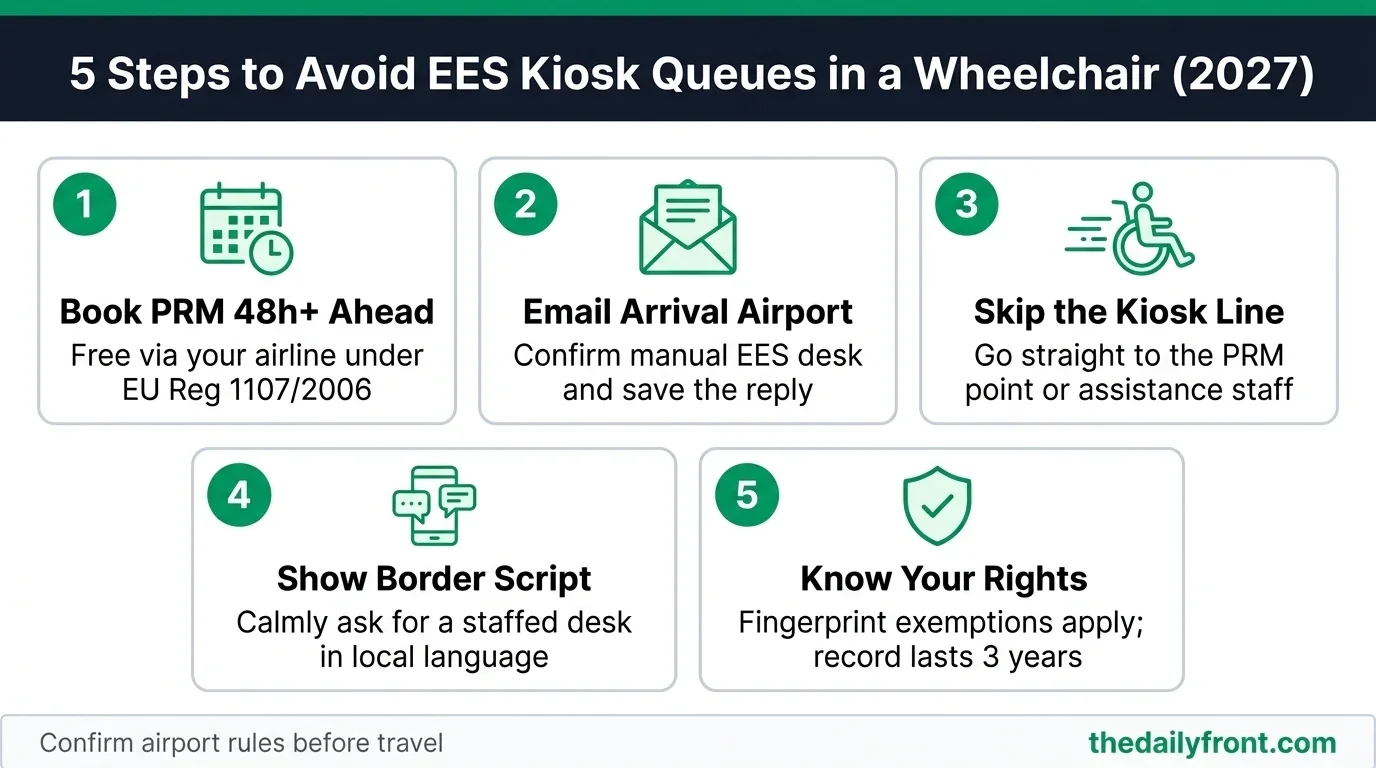
- Book free PRM assistance at least 48 hours ahead. Under EU Regulation (EC) 1107/2006, European airports must assist disabled and reduced-mobility passengers at no extra charge. Notify your airline, travel agent, or tour operator when booking and no later than 48 hours before departure. European Commission interpretative guidelines confirm that providers must still make reasonable efforts to help if you could not pre-notify, though advance booking protects your place in arrival scheduling.
- Confirm whether assistance covers border control. Standard PRM service runs from airport arrival to your aircraft seat, and back out on landing. Email your arrival airport ahead of travel to verify whether the escort accompanies you directly through EES passport control, since procedures vary by terminal.
- Head to the assistance point, not the kiosk line. When you reach immigration, look for PRM signage or an airport assistance vest rather than joining the standing kiosk queue.
- Know your fingerprint rights. EES Regulation (EU) 2017/2226 exempts you from providing fingerprints if doing so is physically impossible. If the barrier is temporary, such as a cast or hand injury, officers log it and may ask for fingerprints on a later trip.
- Consider the Sunflower lanyard for non-visible disabilities. According to The Independent, the Hidden Disabilities Sunflower network spans 340 airports in 70 countries and 31 airlines. Several hubs allow lanyard wearers to use assistance lanes, and Schiphol hands them out free at its assistance desk.
What to Say at Border Control (Multilingual Script)
Save the relevant line below in your phone notes or screenshot it before takeoff so you can show it directly to border officers or queue staff:
- English: "I use a wheelchair and cannot use the self-service kiosk. Could you register me at a staffed desk, please? I have booked special assistance."
- French (France, Belgium): "J'utilise un fauteuil roulant et je ne peux pas utiliser la borne en libre-service. Pouvez-vous m'enregistrer à un guichet avec agent, s'il vous plaît ? J'ai réservé une assistance spéciale."
- German (Germany, Austria, Switzerland): "Ich nutze einen Rollstuhl und kann den Selbstbedienungskiosk nicht verwenden. Könnten Sie mich bitte an einem besetzten Schalter registrieren? Ich habe besondere Hilfeleistung gebucht."
- Spanish (Spain): "Uso silla de ruedas y no puedo utilizar el quiosco de autoservicio. ¿Podría registrarme en un mostrador atendido, por favor? He reservado asistencia especial."
- Dutch (Netherlands, Belgium): "Ik gebruik een rolstoel en kan de zelfbedieningskiosk niet gebruiken. Kunt u mij alstublieft aan een bemande balie registreren? Ik heb speciale assistentie geboekt."
If there is no visible PRM lane, ask the nearest border officer or airport staff member in an assistance vest. If someone insists you use an inaccessible kiosk anyway, stay calm, repeat that you cannot physically use the machine, and ask politely for a shift supervisor. Note the exact time, terminal, and booth number in case you need to file a formal accessibility complaint with the airport or national enforcement body afterward.
Airport Bottlenecks to Watch in Late 2026 and 2027
Two busy Schengen hubs have active infrastructure changes affecting manual border processing through spring 2027:
- Prague Airport (Terminal 1): A major border-control expansion runs from early September 2026 until the end of April 2027, adding five staffed arrivals booths and four EasyGoGate automated gates. Because automated gates serve eligible European passport holders, the five extra staffed booths are the addition that helps non-EU wheelchair users, as reported by Expats.cz. Passport control remains open throughout construction, though three booths close temporarily during one phase and passenger corridors shift around the work. Ask a Prague Red Team coordinator to direct you before joining any queue.
- Brussels Airport: After technical supplier delays kept pre-registration kiosks from going live smoothly, Brussels Airport announced in October 2026 that it is installing eight additional manual border-control positions by December 2026, followed by six new e-gates in early 2027. Until installation finishes, expect heavier crowding around manual booths during peak morning arrivals.
ETIAS in 2027: Should You Pay for It Yet?
No. The official ETIAS website confirms that ETIAS is not yet operational and no applications are being accepted. The EU removed its earlier last-quarter-of-2026 launch window and stated it will announce the exact start date several months before launch. Euronews reported that a 2027 start now looks more likely, but no date is confirmed. Unofficial scam websites already charge fees for fake ETIAS applications, so wait for the official announcement and apply only on the EU portal.
| ETIAS detail | Verified status (November 2026) |
|---|---|
| Launch date | No official date yet; reports point toward 2027 |
| Application fee | 20 euros (waived for applicants under 18 or over 70) |
| Validity | Up to 3 years or until passport expiry, multiple short entries |
| Geographic coverage | 30 European countries |
| Applications open? | No (do not pay any third-party site) |
Once active, ETIAS will apply to visa-exempt nationals including travelers from the UK, US, Canada, and Australia. It is a pre-travel authorization linked electronically to your passport, not a visa. Travelers under 18 and over 70 are exempt from the 20-euro fee, though they still must submit an application once the system opens.
Overall Verdict for Wheelchair Travelers Entering Europe in 2027
EES, ongoing terminal expansions, and an unscheduled ETIAS rollout make 2027 a transitional year at European borders. The kiosks were designed for standing passengers, not wheelchair users, and peak waits remain unpredictable. Even so, you are not powerless in the arrivals hall: booking PRM assistance 48 hours ahead, emailing your arrival airport for written confirmation, carrying the local-language border script, and building extra connection buffer into your itinerary remove most of the guesswork.
Once you clear border control, your next challenge is getting from the terminal to cobbled historic centers smoothly. Plan your onward trains, accessible transfers, and city sights using our Europe Wheelchair Accessible Travel Guide or browse our full collection of Europe wheelchair accessibility guides.
Before You Fly Checklist and Verified Official Sources
- Check passport validity for your entire Schengen trip (plus at least three months beyond your planned departure date).
- Book PRM assistance at least 48 hours ahead and save the booking confirmation showing the assistance code.
- Email your arrival airport's PRM desk to confirm how wheelchair users complete EES registration, and save their reply offline.
- Store airline and airport assistance phone numbers in your phone contacts before boarding.
- Screenshot the border control script above in English and the local language of your arrival country.
- Pack essential medication, power-chair chargers, and spare parts in your carry-on in case border delays stretch your arrival day.
- Leave extra transfer buffer time before booking non-refundable onward trains, taxis, or timed attraction tickets.
| Official source / airport | Use it for | Verified link |
|---|---|---|
| European Union EES Portal | Official EES rules, 29 covered countries, and biometric requirements | travel-europe.europa.eu/ees |
| Official ETIAS Website | Checking real launch dates and avoiding third-party scam sites | travel-europe.europa.eu/etias |
| EU Regulation (EC) 1107/2006 | Legal right to free airport PRM assistance across the EU | EUR-Lex 1107/2006 |
| EES Regulation (EU) 2017/2226 | 3-year record retention and physical fingerprint exemption rules | EUR-Lex 2017/2226 |
| Major Airport PRM Hubs | Confirming local EES manual desk and assistance arrangements | Brussels | Munich | Schiphol | Aena Spain | Prague |
Frequently Asked Questions About EES for Wheelchair Users
Is EES mandatory for wheelchair users entering Europe?
Yes. EES biometric registration is mandatory for all non-EU short-stay travelers visiting the 29 Schengen countries for up to 90 days in any 180-day period. Wheelchair users cannot skip registration, but you do not have to use standing self-service kiosks. Border officers can register your passport, fingerprints, and facial image manually at staffed desks.
How long does EES biometric registration stay valid after my first trip?
Once your initial EES biometric profile is recorded, your digital file remains stored for three years from your last exit, or until your passport expires if that comes sooner. On repeat trips to the Schengen area within that period, border officers verify your identity against your existing record instead of repeating full enrolment.
Which European airports offer wheelchair accessible alternatives to EES kiosks?
Several major hubs confirm manual or assisted options for passengers with reduced mobility. Brussels and Munich process reduced-mobility travelers at staffed border counters, Amsterdam Schiphol offers assistance-lounge kiosks and a dedicated PRM lane, and Aena airports in Madrid and Barcelona run separate manual queues. Because setups change quickly, email your arrival airport before flying.
What should I say at border control if I cannot reach the EES kiosk?
Tell the nearest border officer or assistance staff member: "I use a wheelchair and cannot use the self-service kiosk. Could you register me at a staffed desk, please? I have booked special assistance." If an officer still directs you to an inaccessible kiosk, stay calm, repeat that you cannot use it, and ask for a supervisor.
What if I cannot provide fingerprints for EES because of a disability?
Under EES Regulation (EU) 2017/2226, travelers are legally exempt from giving fingerprints if providing them is physically impossible due to a permanent disability or condition. If the inability is temporary, such as a hand injury or cast, border officers record the temporary exemption in your file and may request fingerprints on a future crossing.
How long are EES border queues for wheelchair users in 2026 and 2027?
Queue times vary widely by airport, arrival wave, and staffing. Industry groups including ACI Europe and Airlines for Europe reported in October 2026 that peak EES waits still routinely exceed two hours and reach five hours in extreme cases. While PRM lanes help you avoid standing kiosks, staffed desks can also experience delays, so budget extra buffer time.
Do I need to apply or pay for ETIAS for a 2027 trip to Europe?
Not yet. As of November 2026, ETIAS is not operational, applications are closed, and the EU has not confirmed an official launch date, though reports point toward 2027. When it opens, ETIAS will cost 20 euros for most visa-exempt travelers, with fees waived for under-18s and over-70s. Never pay any third-party website before official launch.
Border infrastructure, airport PRM procedures, and ETIAS rollout timelines change frequently. Always verify arrival arrangements directly with your airline, airport, and official EU portals before traveling.
Explore More Accessible Travel Guides
- Planning a multi-city European route? Start with our Europe Wheelchair Accessible Travel Guide or explore all city reports in our Europe wheelchair accessibility archive.
- Flying into Germany's main arrival hubs? Compare Can You Really Explore Munich in a Wheelchair? and Can You Really Explore Frankfurt in a Wheelchair?.
- Connecting from a US airline before Europe? Read our US DOT Airline Wheelchair Rule Pause: 2026 Travel Guide to see which US gate protections remain active.
- Heading south to central Italy after clearing customs? Check Is Gubbio Wheelchair Accessible? Top 6 Sights Tested.
- Want first-hand community perspectives? Browse 10 Independent Wheelchair Travel Blogs to Follow in 2026.
Discussion
No comments yet. Be the first to share your thoughts.
Leave a comment